
How to Increase Myokines Naturally With Exercise

If you’re looking for how to increase myokines naturally, exercise gives us the clearest answer. Contracting skeletal muscle releases signaling molecules that can communicate with tissues throughout the body.
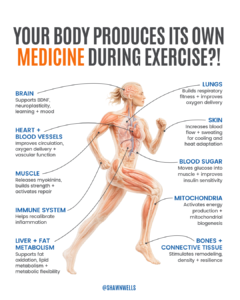
Some of these molecules are called myokines. Research on skeletal muscle as a secretory organ has identified muscle-derived signals involved in communication with fat tissue, the liver, bone, blood vessels, the immune system, and the brain.
Muscle contraction also changes blood flow, fuel use, hormones, nervous-system activity, mechanical loading, and cellular energy demand. Myokines operate alongside all of these responses, which is why researchers are increasingly interested in muscle as more than tissue that moves the body.
What Are Myokines?
Myokines are proteins, peptides, and other signaling molecules produced or released by skeletal muscle. Some act inside or near the muscle that produced them. Others can enter circulation and reach more distant tissues.
IL-6, IL-15, myostatin, and irisin are among the better-known examples, although the evidence around each one varies. Researchers have identified many more candidate myokines, and the list continues to grow as laboratory methods improve.
You may also see the term exerkines in exercise research. Exerkines are the wider group of signaling molecules released in response to exercise from muscle, fat, liver, bone, the heart, and other tissues. Myokines refer specifically to signals coming from skeletal muscle.
Studying these molecules has helped expand our understanding of what happens during exercise. A working muscle is using fuel and generating force while also exchanging chemical information with the rest of the body.
How to Increase Myokines Naturally
Both resistance training and aerobic exercise have been studied for their effects on myokine signaling. A systematic review of 62 human studies found changes following both forms of exercise, with substantial variation depending on the myokine measured, exercise intensity, duration, training status, and timing of the blood sample.
- Resistance training
Squats, rows, presses, lunges, hinges, machines, bands, and bodyweight exercises all create repeated muscle contractions under mechanical load. Human research has reported changes in signals including IL-6, IL-15, and IL-1 receptor antagonist after resistance exercise. For someone training for general health, 2–3 full-body sessions per week can cover the major muscle groups without requiring a complicated split. - Aerobic exercise
Brisk walking, cycling, swimming, hiking, rowing, and running involve repeated contractions over a longer period while increasing oxygen and fuel demand. A recent meta-analysis of endurance exercise reported acute changes in several immunoregulatory signals, including IL-6, IL-10, IL-1ra, IL-8, and IL-15. The response can change with intensity, duration, and training status, so a highly trained person may respond differently from someone who is new to exercise. - Daily movement
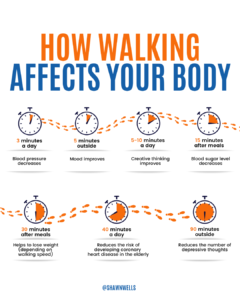
Walking after meals, taking the stairs, carrying groceries, gardening, and getting up during a long workday all require skeletal muscle contraction. In a 2026 meta-analysis, short activity breaks during prolonged sitting improved post-meal glucose and insulin responses, with walking breaks performing particularly well.
What Do Myokines Do in the Body?
Much of the interest in myokines comes from the way muscle communicates with organs and tissues outside the muscles being trained.
Blood Sugar and Metabolism
Skeletal muscle is one of the main places the body sends glucose after a meal. When muscle contracts, fuel demand rises and GLUT4 glucose transporters move toward the cell surface, where they can help bring glucose into the muscle.
Exercise can activate this process through pathways that work partly independently of insulin. A recent review of skeletal muscle glucose uptake describes how insulin signaling and muscle contraction use overlapping but distinct mechanisms to regulate GLUT4.
Researchers are also studying myokines for their roles in glucose handling, fat metabolism, and insulin sensitivity. IL-6, for example, changes rapidly during exercise and participates in the regulation of fuel availability.
People who notice energy crashes, hunger soon after eating, or large swings in how they feel after meals may find my article on blood sugar and energy useful for understanding the wider metabolic picture.
Brain Signaling
Working muscle also communicates with the brain through several routes. Exercise changes blood flow, neurotransmitter activity, growth factors, energy metabolism, and circulating signals from multiple tissues.
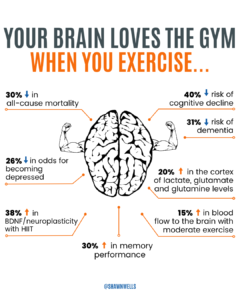
BDNF, or brain-derived neurotrophic factor, often comes up in exercise research because of its involvement in learning and neuroplasticity. Exercise can raise circulating BDNF in humans, although several tissues contribute to BDNF levels, so it should not be treated as a purely muscle-derived signal.
Researchers are continuing to investigate other pathways involved in muscle-brain communication. The broader evidence around exercise and brain health includes effects on cognition, cerebral blood flow, metabolic health, and brain-derived growth factors.
Immune and Inflammatory Signaling
IL-6 is especially interesting because its role changes with context.
Chronically elevated IL-6 is often discussed in relation to inflammation. During exercise, contracting skeletal muscle can also release a substantial amount of IL-6 over a relatively short period. Muscle-derived IL-6 participates in fuel regulation and immune signaling and can be followed by increases in mediators such as IL-10 and IL-1 receptor antagonist.
Research into exercise-induced IL-6 signaling has helped show why the source, timing, and duration of a signal matter when interpreting what it is doing in the body.
Mitochondria and Energy
Muscle energy demand rises quickly during exercise. ATP is used faster, calcium signaling changes, and cellular energy sensors respond to the workload.
Repeated training can increase mitochondrial content and improve the muscle’s capacity to produce energy. PGC-1α is one of the major regulators studied in this process, and a recent human meta-analysis of endurance training found increases in PGC-1α following exercise.
Myokine signaling intersects with these metabolic pathways. The working muscle is simultaneously responding to energy stress, mechanical tension, oxygen demand, calcium flux, and signals generated during contraction. I cover these adaptations in more depth in my article on mitochondrial function.
Bone
Muscle and bone are closely connected mechanically. When skeletal muscle contracts during lifting, walking, or jumping, it places force on bone.
Researchers have also identified chemical communication between the two tissues. Muscle releases myokines, while bone produces signaling molecules often called osteokines. Current work on muscle-bone crosstalk is examining how these signals interact with physical loading, muscle mass, and bone remodeling.
This relationship becomes increasingly relevant with age, when muscle mass, strength, and bone can all decline at the same time.
Does Walking Increase Myokines?
Walking involves repeated contraction of the muscles in the legs and hips, so it can stimulate exercise-related signaling. Research cannot currently tell us that a specific step count produces a specific increase in myokines.
Study conditions vary widely. Walking speed, duration, fitness level, age, the timing of blood samples, and laboratory methods can all change the result. Many myokines also rise and fall over relatively short periods.
A brisk walk places more metabolic demand on muscle than an easy stroll. Hills and stairs increase the workload further. Walking after eating has the added advantage of putting large leg muscles to work at a time when glucose is entering the bloodstream.
Someone sitting for most of the workday may benefit from thinking about walking as several bouts of muscle activity rather than one daily step total. Resistance training can then provide the heavier mechanical loading that normal walking does not.
What Is the Best Exercise for Myokines?
Human research has not identified a single exercise that consistently produces the most favorable response across all myokines. Resistance training, moderate aerobic work, and higher-intensity exercise each produce different signaling patterns.
A weekly routine can combine these forms of activity without becoming complicated. 2-3 resistance sessions can cover strength and mechanical loading. Walking keeps muscles active throughout the day. Brisk walking, cycling, swimming, hiking, or similar aerobic work can build cardiovascular capacity. Intervals can be used when training experience and recovery support them.
There is little value in trying to produce the biggest possible spike in one molecule such as IL-6 or irisin. We do not have evidence showing that maximizing an individual myokine leads to a better long-term outcome.
How well the program is working is easier to judge through changes in strength, aerobic fitness, exercise tolerance, muscle mass, and recovery.
Can You Test Your Myokine Levels?
Individual myokines can be measured in research laboratories and some specialty settings. There is currently no established consumer test that can tell you whether your overall myokine signaling is optimal.
A single result would also be difficult to interpret. Myokine concentrations can change during exercise and again in the hours afterward. Recent meals, body composition, training status, exercise intensity, and the assay used by the laboratory can influence the number.
Tracking strength, aerobic fitness, muscle mass, walking pace at a given heart rate, recovery, and performance over time provides information that is easier to use. I take a similar approach when discussing whether you can test mitochondrial health, because complex systems rarely reduce neatly to one blood marker.
Can Food or Supplements Increase Myokines?
Researchers are studying nutrients and bioactive compounds that may influence myokine-related pathways. The quality of evidence varies considerably, and some of the findings still come from cell or animal research.
A recent review covering myokines and metabolic regulation discusses several compounds under investigation while noting important gaps in human evidence. Claims around a specific “myokine-boosting” food or supplement are ahead of what the clinical research can currently support.
Nutrition can still influence the training response. Protein provides amino acids used in muscle repair and maintenance. Carbohydrates help supply fuel for longer or harder sessions. Creatine can improve strength, power, and training capacity in many people.
Those effects can help someone train more effectively, which gives muscle more opportunities to receive and respond to the stimulus created by exercise. In my guide to workout supplements for energy, strength, and recovery, I organize supplements around those measurable outcomes rather than individual signaling molecules.
For how to increase myokines naturally, the evidence is much clearer around movement itself. Walking, resistance training, aerobic exercise, and simply spending less of the day inactive all give skeletal muscle more opportunities to contract and send these signals.
References
Abrego-Guandique, D. M., Aguilera Rojas, N. M., Chiari, A., Luciani, F., Cione, E., & Cannataro, R. (2025). The impact of exercise on mitochondrial biogenesis in skeletal muscle: A systematic review and meta-analysis of randomized trials. Biomolecular concepts, 16(1), 20250055.
Aslam, M. A., Lee, J., Scott Bowen, T., & Huh, J. Y. (2026). Exercise-induced myokines in metabolic regulation: mechanisms, mimetics, and translational potential. Archives of Pharmacal Research, 1-39.
Bettariga, F., Taaffe, D. R., Galvao, D. A., Lopez, P., Bishop, C., Markarian, A. M., … & Newton, R. U. (2024). Exercise training mode effects on myokine expression in healthy adults: A systematic review with meta-analysis. Journal of Sport and Health Science, 13(6), 764-779.
Cariati, I., Bonanni, R., Onorato, F., Mastrogregori, A., Rossi, D., Iundusi, R., … & Tarantino, U. (2021). Role of physical activity in bone–muscle crosstalk: Biological aspects and clinical implications. Journal of functional morphology and kinesiology, 6(2), 55.
Gale, J. T., Martin, H., Haszard, J. J., & Peddie, M. C. (2026). The Acute Effects of Interrupting Prolonged Sitting With Regular Activity Breaks on Postprandial Glucose and Insulin in Adults: A Systematic Review and Meta‐Analysis. Obesity Reviews, e70152.
Petersen, A., & Pedersen, B. (2006). The role of IL-6 in mediating the anti inflammatory. J physiol pharmacol, 57(Suppl 10), 43-51.
Richter, E. A., Bilan, P. J., & Klip, A. (2025). A comprehensive view of muscle glucose uptake: regulation by insulin, contractile activity, and exercise. Physiological reviews, 105(3), 1867-1945.
Ringleb, M., Fabritius, F., Godde, J., Puta, C., Bloch, W., & Javelle, F. (2026). Circulating myokine responses to acute endurance exercise and their role in immunoregulation: a systematic review and meta‐analysis. The FASEB Journal, 40(4), e71536.
Severinsen, M. C. K., & Pedersen, B. K. (2020). Muscle–organ crosstalk: the emerging roles of myokines. Endocrine reviews, 41(4), 594-609.
Share

Who is Shawn Wells?
Although I’ve suffered from countless issues, including chronic pain, auto-immunity, and depression, those are the very struggles that have led me to becoming a biochemist, formulation scientist, dietitian, and sports nutritionist who is now thriving. My personal experiences, experiments, and trials also have a much deeper purpose: To serve you, educate you, and ultimately help you optimize your health and longevity, reduce pain, and live your best life.



ORDER THE ENERGY FORMULA
Discover the 6 foundational pillars to cultivate a more caring, compassionate, connected, unified and purpose-filled life.
Hardcover, Audible & EBook Available!
UNLEASH YOUR UNLIMITED POTENTIAL
