
9 Things Women Should Know Before Building a Menopause Supplement Stack

Perimenopause vs Menopause Supplements can get confusing because most advice treats every woman over 40 like she needs the same stack.
That is not how the body works.
A woman with regular cycles and PMS has different needs than a woman dealing with night sweats, irregular periods, and new sleep issues. A woman who is already postmenopausal may need a different strategy again, especially when muscle, bone health, brain function, and metabolic health become bigger priorities.
Menopause is not a supplement deficiency. It is a natural transition, but it can change how the body responds to stress, sleep, food, training, and recovery.
Supplements can help support those systems when they are chosen with purpose.
The goal is not to take everything. The goal is to understand where you are, what you are trying to support, and which ingredients make sense for that stage.
Perimenopause vs Menopause Supplements: Why the Stage Matters
Before building a stack, it helps to separate pre-menopause, perimenopause, and menopause.
Pre-menopause usually means you are still having regular cycles. The focus is often mood, PMS support, cycle comfort, sleep, hydration, energy, and nutrient status.
Perimenopause is the transition leading up to menopause. Cycles may become irregular, hormones can fluctuate more, and symptoms may shift from month to month. A review on the management of perimenopause describes symptoms such as hot flashes, sleep changes, mood shifts, sexual changes, and bleeding pattern changes.
Menopause is confirmed after 12 months without a menstrual period. After that, the strategy often moves toward long-term support for muscle, bone density, cognition, cardiovascular health, glucose metabolism, and healthy aging.
This is why I prefer a stage-based stack over a generic “hormone balance” product.
1. Pre-Menopause Support: Build the Foundation Early
Pre-menopause is not usually the time for an aggressive menopause stack. It is the time to strengthen the basics that support a healthier transition later.
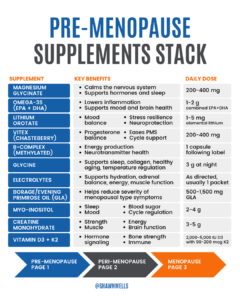
These are the supplements that fit that foundation:
- Magnesium glycinate for nervous system calm, sleep, and muscle relaxation.
- Omega-3s from EPA and DHA for mood, brain health, and inflammatory balance.
- Lithium orotate for mood and stress resilience, with clinician guidance if there are thyroid, kidney, psychiatric, or medication considerations.
- Vitex (chasteberry) for progesterone balance, PMS support, and cycle support.
- Methylated B-complex for energy production and neurotransmitter health.
- Glycine for sleep, collagen support, healthy aging, and nighttime temperature regulation.
- Electrolytes for hydration, energy, adrenal balance, and muscle function.
- Borage oil or evening primrose oil for GLA, which may support skin and hormone-related comfort.
- Myo-inositol for sleep, mood, blood sugar support, and cycle regulation.
- Creatine monohydrate for strength, muscle, energy, and brain function.
- Vitamin D3 with K2 for hormone signaling, bone strength, and immune health.
For many women, magnesium is one of the most useful places to start because it connects to sleep, stress response, muscle function, and energy metabolism. I cover this in more detail in my Magnesium Guide.
The bigger idea is to stop waiting until symptoms become disruptive before supporting the systems that are already working hard.
2. Perimenopause Support: Match the Stack to the Symptoms
Perimenopause is often the most unpredictable stage.
Some months may feel normal. Other months may bring poor sleep, hot flashes, night sweats, heavier periods, anxiety, brain fog, or changes in body composition.
The stack should reflect what is actually happening, not just what the front of a bottle promises.
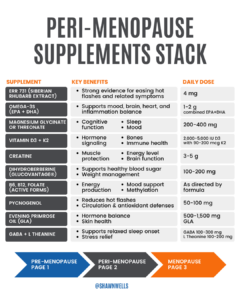
At this stage, the stack becomes more targeted:
- ERr 731, a Siberian rhubarb extract for hot flashes and related menopausal symptoms.
- Omega-3s from EPA and DHA for mood, brain, heart, and inflammatory balance.
- Magnesium glycinate or threonate for sleep, cognition, mood, and nervous system support.
- Vitamin D3 with K2 for hormone signaling, bone health, and immune support.
- Creatine for muscle protection, energy level, and brain function.
- Dihydroberberine (GlucoVantage) for healthy blood sugar and weight management support.
- Active B6, B12, and folate for energy production, methylation, and mood support.
- Pycnogenol for hot flash support, circulation, and antioxidant defenses.
- Evening primrose oil for GLA and hormone-related comfort.
- GABA with L-theanine for relaxed sleep onset and stress relief.
Several of these ingredients have human research behind them, but the evidence is not equal across every symptom. ERr 731 has been studied for menopausal symptoms, while ingredients like omega-3s, magnesium, creatine, and B vitamins are better viewed as system support.
For women with frequent or severe hot flashes, night sweats, heavy bleeding, sudden mood changes, or sleep loss that affects daily life, supplements should not be the only plan. A review on vasomotor symptoms during menopause notes that hormone therapy remains one of the most effective options for many women, though the decision should be individualized with a clinician.
3. Menopause Support: Think Muscle, Bone, Brain, and Metabolism
After menopause, the goal shifts from chasing every symptom to protecting long-term function.
This is where I want women thinking more seriously about muscle, bone health, cognition, cardiovascular health, glucose metabolism, mitochondrial energy, and recovery.
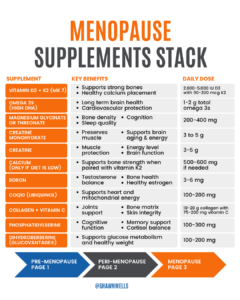
After menopause, the stack should be more focused and selective:
- Vitamin D3 with K2 as MK-7 for bone support and healthy calcium placement.
- Omega-3s with higher DHA for long-term brain and cardiovascular support.
- Magnesium glycinate or threonate for bone density, cognition, sleep, and nervous system support.
- Creatine monohydrate for muscle protection, energy, brain function, and healthy aging.
- Calcium only if dietary intake is low.
- Boron for testosterone balance, bone health, and healthy estrogen balance.
- CoQ10 as ubiquinol for heart health and mitochondrial energy.
- Collagen with vitamin C for joints, skin integrity, connective tissue, and the bone matrix.
- Phosphatidylserine for cognition, memory support, and cortisol balance.
- Dihydroberberine, including GlucoVantage for healthy glucose metabolism and healthy weight management.
Creatine is one of the most practical tools in this stage because muscle is strongly tied to aging well. It may support strength, training performance, and lean mass when paired with resistance training. I explain the practical side in my creatine guide.
Calcium needs more context. I do not like seeing high-dose calcium used automatically after menopause. If diet is low, calcium may help fill the gap, but bone support also depends on vitamin D, K2, magnesium, protein, resistance training, and personal risk factors.
4. Know When Supplements Are Not Enough
Supplements can support normal structure and function. They are not meant to treat, cure, or prevent disease.
That is especially important during perimenopause and menopause because symptoms can overlap with thyroid issues, anemia, mood disorders, sleep disorders, medication effects, and other health concerns.
Talk with a qualified clinician if you have:
- Heavy or unusual bleeding
- Severe mood changes
- Intense hot flashes or night sweats
- Sleep loss that affects daily life
- Vaginal symptoms
- New pain
- Thyroid concerns
- A history of hormone-sensitive cancer
- Kidney or liver disease
- Medications that may interact with supplements
A smart supplement stack works best when it is part of a bigger health strategy, not a substitute for proper evaluation.
5. Build Around One Main Priority First
The most common mistake is adding too many products at once.
When sleep is the priority, start with the routine itself: caffeine timing, alcohol intake, room temperature, magnesium, glycine, GABA, and L-theanine.
For muscle support, the foundation is protein, resistance training, creatine, recovery, and enough total calories.
Blood sugar support should begin with the basics too: protein at breakfast, fiber, meal timing, walking after meals, sleep, magnesium, and targeted support such as dihydroberberine when appropriate.
For hot flashes, it helps to track patterns around stress, alcohol, sleep environment, and common triggers while looking at ingredients that have been studied for that symptom.
This keeps the stack easier to evaluate and reduces the chance of taking multiple formulas that repeat the same ingredients.
6. Muscle and Bone Deserve More Attention After 40
Many women are taught to focus on weight. I would rather see more women focus on strength, body composition, and resilience.
Muscle supports glucose disposal, mobility, metabolism, and independence. Bone health becomes more important as hormonal changes influence bone remodeling.
The foundation is still food and training:
- Eat enough protein
- Strength train consistently
- Recover well
- Sleep enough
- Use creatine to support the training signal
- Use collagen with vitamin C as connective tissue support, not as your main protein
Human trials suggest creatine works best when paired with resistance training. That is the lens I use for most supplements in this category. The ingredient should support the work, not replace it.
7. Look at Sleep and Blood Sugar Before Blaming Hormones
Poor sleep can make mood, cravings, energy, recovery, and brain fog worse.
Perimenopause and menopause can affect sleep through hot flashes, night sweats, stress, alcohol sensitivity, glucose swings, and hormone changes. A review on sleep during the menopausal transition discusses how vasomotor symptoms and reproductive hormone changes may influence sleep quality.
Blood sugar can also shift during this time. Skipping protein, fasting too aggressively, relying on caffeine, or under-recovering from exercise can make energy swings and cravings more noticeable.
Dihydroberberine may support healthy glucose metabolism, but it is not a casual add-on for everyone. Anyone using glucose-lowering medication, GLP-1 medication, or medication that affects appetite or blood sugar should speak with a clinician before using berberine-type ingredients.
I wrote more about the energy side of this in my article on blood sugar and energy.
8. Label Quality Matters More With Hormone-Positioned Products
Women’s hormone products can be hard to evaluate because many use long ingredient lists and proprietary blends.
Before buying, check for:
- The exact form of each ingredient.
- The dose per serving.
- The amount of EPA and DHA in omega-3 products.
- The form of magnesium.
- The form of vitamin K2.
- Whether botanicals are standardized.
- Whether the formula hides behind a proprietary blend.
- Whether multiple products repeat the same ingredient.
Ingredient form matters. Magnesium glycinate is not the same as magnesium oxide. Vitamin K2 as MK-7 is more specific than generic vitamin K. Fish oil weight is not the same as EPA and DHA content.
9. Track the Stack Like an Experiment
A stack should be simple enough to evaluate.
If you add 10 supplements in the same week, you will not know what helped, what did nothing, or what caused side effects.
Choose one or two priorities and track the markers that match:
- Sleep quality
- Nighttime wakeups
- Hot flash frequency
- Morning energy
- Cravings
- Mood
- Training performance
- Recovery
- Cycle changes if still menstruating
- Digestion
- Blood sugar markers if you are tracking them
Give the plan enough time to show a pattern, then adjust based on feedback.
Supplements I Would Be Careful With
Some supplements may be useful in the right situation, but I would not use them casually.
- Iron may be important when labs show a need, especially with heavy periods, but it should not be taken blindly after menopause.
- Calcium may help when dietary intake is low, but high-dose calcium without a broader bone plan is not ideal.
- Stimulant fat burners can worsen sleep, anxiety, hot flashes, and blood pressure in some women.
- High-dose melatonin can leave some people groggy and does not always improve sleep quality.
- Proprietary hormone blends make it hard to judge dose, safety, and purpose.
- Multiple overlapping formulas can lead to unnecessary duplication, especially with B vitamins, herbs, magnesium, GABA, and adaptogens.
A smaller stack with a clear reason behind each ingredient is usually better than a large stack built out of frustration.
FAQ: Perimenopause vs Menopause Supplements
What is the difference between perimenopause and menopause?
Perimenopause is the transition before menopause, when hormones fluctuate and periods may become irregular. Menopause is confirmed after 12 months without a menstrual period.
Do pre-menopause, perimenopause, and menopause need different supplements?
Often, yes. Pre-menopause support usually focuses on cycle comfort, mood, sleep, hydration, and nutrient status. Perimenopause support often focuses on fluctuating symptoms such as hot flashes, sleep changes, brain fog, and glucose shifts. Menopause support often shifts toward muscle, bone, brain, cardiovascular, and metabolic health.
What supplements are commonly used before perimenopause?
Common options include magnesium glycinate, omega-3s, lithium orotate, vitex, methylated B-complex, glycine, electrolytes, borage oil or evening primrose oil, myo-inositol, creatine monohydrate, and vitamin D3 with K2.
What supplements are commonly used during perimenopause?
Common options include ERr 731, omega-3s, magnesium glycinate or threonate, vitamin D3 with K2, creatine, dihydroberberine, active B6, B12 and folate, Pycnogenol, evening primrose oil, GABA, and L-theanine.
What supplements are commonly used after menopause?
Common options include vitamin D3 with K2 as MK-7, omega-3s with higher DHA, magnesium glycinate or threonate, creatine monohydrate, calcium if diet is low, boron, ubiquinol CoQ10, collagen with vitamin C, phosphatidylserine, and dihydroberberine.
Can supplements help with hot flashes?
Some ingredients have been studied for menopausal symptoms, including hot flashes, but results vary. Frequent or severe hot flashes should be discussed with a qualified clinician.
Can supplements replace hormone therapy?
No. Supplements may support certain systems, but they do not replace hormone therapy or medical care.
Final Thoughts
Perimenopause vs Menopause Supplements should be stage-based, not random.
Before perimenopause, the focus is often sleep, mood, cycle comfort, hydration, and nutrient status.
During perimenopause, the stack may need to adjust as symptoms fluctuate.
After menopause, the strategy usually shifts toward muscle, bone, brain, cardiovascular health, glucose metabolism, and recovery.
A useful stack has a clear purpose, transparent doses, and a way to measure whether it is helping.
For more science-backed supplement and health strategies, subscribe to my weekly newsletter and I’ll help you stay on top of your health with practical insights you can actually use.
References
Baker, F. C. (2023). Optimizing sleep across the menopausal transition. Climacteric, 26(3), 198–205.
Delamater, L., & Santoro, N. (2018). Management of the perimenopause. Clinical Obstetrics and Gynecology, 61(3), 419–432.
Khan, S. J., Kapoor, E., Faubion, S. S., & Kling, J. M. (2023). Vasomotor symptoms during menopause: A practical guide on current treatments and future perspectives. International Journal of Women’s Health, 15, 273–287.
Kreider, R. B., Kalman, D. S., Antonio, J., Ziegenfuss, T. N., Wildman, R., Collins, R., Candow, D. G., Kleiner, S. M., Almada, A. L., & Lopez, H. L. (2017). International Society of Sports Nutrition position stand: Safety and efficacy of creatine supplementation in exercise, sport, and medicine. Journal of the International Society of Sports Nutrition, 14, 18.
The North American Menopause Society. (2022). The 2022 hormone therapy position statement of The North American Menopause Society. Menopause, 29(7), 767–794.
The North American Menopause Society. (2023). The 2023 nonhormone therapy position statement of The North American Menopause Society. Menopause, 30(6), 573–590.
Weaver, C. M., Gordon, C. M., Janz, K. F., Kalkwarf, H. J., Lappe, J. M., Lewis, R., O’Karma, M., Wallace, T. C., & Zemel, B. S. (2016). The National Osteoporosis Foundation’s position statement on peak bone mass development and lifestyle factors: A systematic review and implementation recommendations. Osteoporosis International, 27(4), 1281–1386.
Share

Who is Shawn Wells?
Although I’ve suffered from countless issues, including chronic pain, auto-immunity, and depression, those are the very struggles that have led me to becoming a biochemist, formulation scientist, dietitian, and sports nutritionist who is now thriving. My personal experiences, experiments, and trials also have a much deeper purpose: To serve you, educate you, and ultimately help you optimize your health and longevity, reduce pain, and live your best life.


ORDER THE ENERGY FORMULA
Discover the 6 foundational pillars to cultivate a more caring, compassionate, connected, unified and purpose-filled life.
Hardcover, Audible & EBook Available!
UNLEASH YOUR UNLIMITED POTENTIAL
