
The Supplement Pyramid: How I Prioritize Supplements for Energy, Health, and Longevity

A well-built supplement pyramid starts with the same principle I use in my own work: most people do not need more supplements, they need better priorities. I see too many people build their routine upside down, spending money on advanced longevity compounds or niche performance tools while the basics are still shaky, things like low protein intake, poor mineral status, inconsistent hydration, or weak recovery. I think a smarter approach is to build from the ground up, using supplements to fill real gaps instead of chasing whatever sounds cutting-edge. That is also much closer to how the NIH Office of Dietary Supplements and the FDA frame supplementation: as support for the diet, not a replacement for it.
This is not meant to be a one-size-fits-all stack. It is the framework I use to think about what belongs first, what belongs later, and what only makes sense when there is a clear goal, symptom pattern, training demand, or lab-based reason to use it. When I look at supplements that way, the noise drops fast.
What the Supplement Pyramid Is Really About
The supplement pyramid is a prioritization model. At the base are the supplements with the broadest practical value for health-conscious adults, especially those trying to support energy, resilience, body composition, recovery, and long-term health. As you move up the pyramid, the supplements become more specialized. They may still be useful, sometimes very useful, but they are less universal, more context-dependent, and usually more appropriate once the foundation is already in place.
That distinction matters because wellness culture often rewards novelty over sequence. In my experience, though, sequence is what usually determines whether a supplement routine feels effective or just expensive. A foundational stack covers common gaps first. A more advanced stack assumes those gaps are already handled.
Before I get into the tiers, I want to make one thing clear. Food still comes first. The current Dietary Guidelines for Americans continue to center healthy eating patterns as the basis for meeting nutrient needs, while federal guidance on supplements consistently positions them as a way to fill gaps when needed. That is exactly how I think people should use them.
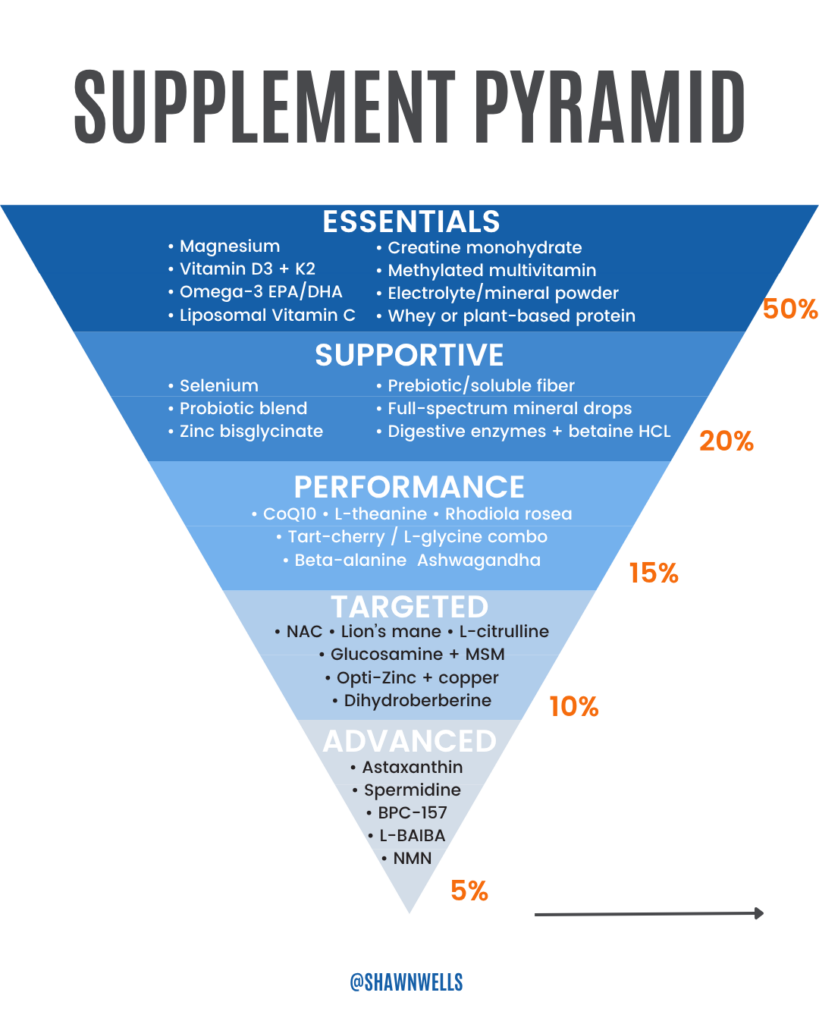
The Foundation of My Supplement Pyramid: Essentials
If I am building a routine from scratch, this is where I start. These are the supplements that cover the biggest weak links I see in real life: nutrient gaps, energy production, immune support, hydration, muscle maintenance, and recovery.
Vitamin D3 + K2
Vitamin D belongs near the base of my supplement pyramid because it is tied to calcium absorption, bone health, and immune function, and because low vitamin D status is still common. The NIH’s vitamin D guidance notes that vitamin D is needed for good health and that very few foods naturally contain much of it. That matters even more for people with limited sun exposure, darker skin, older age, or diets that are low in vitamin D-rich foods.
I like pairing D3 with K2 conceptually because most people thinking seriously about vitamin D are also thinking about calcium handling and long-term bone support, not just one isolated nutrient.
Recommended products:
Magnesium glycinate or taurate
Magnesium is foundational because it plays roles in muscle and nerve function, blood sugar regulation, blood pressure regulation, and the making of protein, bone, and DNA. The NIH also notes that many people in the U.S. do not get enough magnesium from food. That is one reason magnesium shows up so often when people feel “off” despite trying to do a lot of the right things.
It is not flashy, but it is one of the highest-return places to start.
Recommended products:
Omega-3 EPA/DHA
Omega-3s also sit low in the pyramid because most people simply are not eating enough fatty fish. NIH guidance explains that omega-3 fatty acids are important components of cell membranes and that EPA and DHA play key roles in the body. In practice, this is one of the clearest examples of a modern nutritional gap that can be addressed intelligently.
If seafood intake is low, omega-3 support often makes far more sense than jumping straight to a cutting-edge compound.
Recommended products:
Quality whey or plant protein isolate
Protein powder is not exciting, but that is exactly why it earns a place so low in the pyramid. It solves a real compliance problem. A lot of adults, especially busy professionals and people over 40, think they are eating enough protein when they are not consistently getting there.
Protein matters for satiety, recovery, lean mass, and healthy aging. The current Dietary Guidelines place protein foods squarely inside a healthy eating pattern, and that practical reality carries over into supplementation when food intake falls short.
I would always rather see someone hit their basics than spend money on advanced compounds while under-eating protein.
Recommended products:
Electrolyte and mineral support
Hydration is not just about water. Sodium, potassium, and magnesium all help regulate fluid balance, muscle contraction, and nerve signaling. That is why electrolyte support can make such a noticeable difference for active people, people who sweat a lot, people eating lower carb, or anyone whose energy drops hard when hydration slips.
This is one of those categories that gets underestimated because it feels too basic. But in my experience, basics are often where the biggest wins live.
Recommended products:
Creatine monohydrate
Creatine absolutely belongs in the essentials tier. The International Society of Sports Nutrition describes creatine monohydrate as one of the most effective ergogenic nutritional supplements available for increasing high-intensity exercise capacity and lean body mass during training, with a strong safety and efficacy profile in recommended use.
That is one reason I place it so low in the pyramid. It is not just for bodybuilders. It is one of the most researched, practical, and versatile tools in the supplement world.
Recommended products:
Vitamin C and a quality multivitamin
Vitamin C and a well-formulated multivitamin round out the essentials tier for me. NIH guidance notes that vitamin C acts as an antioxidant and is involved in collagen formation and wound healing. A multivitamin, meanwhile, can serve as broad nutritional insurance when food quality, variety, or digestion are not where they need to be.
Neither one replaces the bigger rocks above, but both can help strengthen the base of the stack when used appropriately.
Recommended products:
- Core Med Science Liposomal Vitamin C 1000mg
- Life Extension Vitamin C 24-Hour Liposomal Hydrogel™ Formula
- Pure Encapsulations O.N.E. Multivitamin
The Supportive Layer: Gut Health, Digestion, and Mineral Back-Up
Once the foundation is solid, the next layer of my supplement pyramid is about support. This is where I put tools that help the essentials work better and cover areas a basic stack may still miss, especially digestion, gut health, trace minerals, and immune resilience.
Probiotic blends
Probiotics can be incredibly useful, but I do not consider them universally step one. The NIH’s consumer guidance explains that probiotics are live microorganisms that may provide health benefits when consumed in adequate amounts, but effects are often strain-specific and product-specific.
That is exactly why I place them in supportive rather than essential. In the right context, after antibiotics, during travel, or when gut resilience is clearly compromised, they can matter a lot. But I do not think everyone should take a random probiotic just because the category sounds healthy.
Recommended products:
Prebiotic and soluble fiber
Fiber is one of the least glamorous and most underrated parts of this whole conversation. Government nutrition guidance continues to identify fiber as an underconsumed part of the diet, and Nutrition.gov points back to its importance for digestive health and overall dietary quality.
If whole-food intake is not consistently delivering enough fiber, a smart prebiotic or soluble fiber can be one of the most useful supportive additions I can think of. This is especially true for people who want better satiety, steadier digestion, and a more resilient gut environment.
Recommended products:
Digestive enzymes, betaine HCl, zinc, selenium, and trace minerals
Digestive enzymes and betaine HCl can make sense when digestion is clearly a bottleneck, especially around larger or higher-protein meals. Zinc, selenium, and full-spectrum mineral support can also help tighten weak spots when diet quality, food variety, or mineral status are not where they should be.
I would still rather see someone handle the bigger foundational issues first, but this layer can make a good stack work better.
Recommended products:
- Pure Encapsulations Digestive Enzymes Ultra
- Double Wood Essential Digestive Enzymes
- LVLUP Health – Zinc Carnosine +
- NOW Foods Zinc Picolinate
- THORNE Selenium
- Pure Encapsulations Selenium
The Performance Layer: Output, Recovery, and Focus
This is where articles on supplements can drift into shiny-object territory, so context matters. I think performance supplements should help you do more, recover better, think more clearly, or tolerate stress more effectively. They are not a substitute for sleep, hydration, protein, or the essentials. They are a layer on top of that.
Salidroside, ashwagandha, and L-theanine
This is the resilience-and-focus side of the performance layer. Salidroside, a key active associated with rhodiola, fits here because it is more about stress adaptation and performance than basic nutrition. Ashwagandha can also be useful when stress load is high and recovery is lagging, while L-theanine is one of the cleaner tools for smoothing out overstimulation and supporting calm focus.
These can be great options for the right person, but they belong here, not at the base.
Recommended products:
- Pure Encapsulations Ashwagandha
- Double Wood Ashwagandha Capsules
- Doctor’s Best L-Theanine
- Nutricost L-Theanine
CoQ10 and ubiquinol
CoQ10 earns its place in the performance tier because of its role in mitochondrial energy production. If someone’s foundation is already strong and the next goal is better output, steadier energy, or better recovery, CoQ10 can be a logical next step.
Recommended products:
Beta-alanine, tart cherry, and glycine
These are useful examples of why sequencing matters. Beta-alanine is clearly performance-oriented. Tart cherry and glycine can support recovery and sleep quality. Helpful tools, yes. Foundational tools, no. They make more sense once the bottom of the pyramid is already handled.
Recommended products:
- Nutricost – Tart Cherry Extract
- Carlyle – Tart Cherry Capsules
- NOW Foods – Glycine 1000 mg
- Life Extension – Glycine 1000 mg
The Targeted Layer: Use a Supplement Because You Have a Reason
This is where I want people to get more intentional. A targeted supplement should solve a targeted problem. I want to be able to finish the sentence, “I’m taking this because…”
Dihydroberberine
Dihydroberberine fits when blood sugar and metabolic support are the reason for supplementing. It can be a smart tool. It just should not be the starting point for someone who still has glaring issues lower in the stack.
Recommended products:
Glucosamine + MSM
This is classic targeted support for joints and connective tissue. For the right person, it makes sense. For the average person building a first stack, it comes later.
N-acetyl-cysteine and lion’s mane
NAC sits in this tier because it is tied to a specific kind of use, not broad foundational coverage. Lion’s mane fits here for similar reasons. It is more goal-driven, more specific, and more likely to be used because someone is focused on a particular cognitive outcome rather than general nutritional coverage.
Recommended products:
- NOW Foods NAC (N-Acetyl Cysteine)
- Life Extension N-Acetyl-L-Cysteine (NAC)
- The Genius Brand Genius Lion’s Mane
- Real Mushrooms Lion’s Mane
Citrulline and zinc + copper
Citrulline is clearly a nitric oxide and blood flow play. Zinc + copper is a more deliberate micronutrient pairing than simply grabbing a stand-alone zinc product and hoping for the best. To me, this is what targeted supplementation should look like: clear reason, clear context, clear expectations.
Recommended products:
The Top of My Supplement Pyramid: Advanced Compounds
The top of the supplement pyramid is where people are often most tempted to start, and where I think discipline matters most. This is the 5% layer. These compounds can be interesting, useful, and exciting, but they are not where I think most people should begin.
NMN, spermidine, L-BAIBA, astaxanthin, and BPC-157
This is the territory of deeper experimentation, stronger use cases, bigger budgets, and often more biomarker-driven thinking. NMN and spermidine usually show up in longevity conversations. L-BAIBA and BPC-157 are much more niche. Astaxanthin is promising, but still clearly not foundational.
None of these are bad. They are just later. Starting here before the bottom of the pyramid is handled is usually a great way to overspend and underperform.
Recommended products:
- Healthgevity – NMN 1000+
- Nutricost NMN (Nicotinamide Mononucleotide)
- Pure Synergy SuperPure Astaxanthin
- Nutrex Hawaii BioAstin Hawaiian Astaxanthin
- LVLUP Health – BPC-157 Double Strength
How I Use the Supplement Pyramid Without Wasting Money
The best way I know to use a supplement pyramid is to treat it like a filter.
I start with the bottom. I ask whether diet, protein intake, hydration, omega-3 intake, vitamin D status, and magnesium intake are actually where they need to be. Then I move into support for digestion, fiber, probiotics, and trace minerals if those are obvious weak spots. Only after that do I start layering in performance tools, then targeted tools, then advanced compounds.
This is where my experiment mindset matters. I do not like adding 10 things at once. I do not think every trend is a must-have. I prefer building slowly enough to tell what is helping, what is doing nothing, and what simply does not fit someone’s needs right now.
How I Choose Supplements That Are Actually Worth Buying
A good formula should make sense on paper before it ever ends up in the cart. The FDA’s consumer guidance is helpful here because it explains what must appear on a label, including the Supplement Facts panel, serving size, and ingredient disclosure. The NIH’s general supplement guidance also emphasizes that labels, quality, and safety matter.
I look for transparent labels, sensible forms, meaningful doses, and products that do not hide behind proprietary blends. The more specialized the category, the more important that gets.
In other words, I do not want a kitchen-sink formula that tries to impress with ten underdosed ingredients. I want a product that has a clear job and does that job well.
Final Thoughts
A strong supplement routine should feel thoughtful, not chaotic. The goal is not to collect more bottles. The goal is to cover the basics, support the systems that matter most, and then layer in more specialized tools only when they fit your goals and your real life.
That is why I keep coming back to the supplement pyramid. It gives me a smarter order of operations. It helps people stop chasing the 5% before they have earned the 50%. And it makes supplementation feel less like guesswork and more like strategy.
If you want more practical, science-backed insights like this each week, you can join my newsletter and stay on top of your health without getting buried in hype.
Share

Who is Shawn Wells?
Although I’ve suffered from countless issues, including chronic pain, auto-immunity, and depression, those are the very struggles that have led me to becoming a biochemist, formulation scientist, dietitian, and sports nutritionist who is now thriving. My personal experiences, experiments, and trials also have a much deeper purpose: To serve you, educate you, and ultimately help you optimize your health and longevity, reduce pain, and live your best life.



ORDER THE ENERGY FORMULA
Discover the 6 foundational pillars to cultivate a more caring, compassionate, connected, unified and purpose-filled life.
Hardcover, Audible & EBook Available!
UNLEASH YOUR UNLIMITED POTENTIAL
