
Can You Test Mitochondrial Health? What VO₂ Max, Lactate, Labs, and Wearables Can Tell You

We can measure blood glucose, cholesterol, blood pressure, and body composition relatively easily. Mitochondrial health is harder to assess because mitochondria work inside our cells. There, they convert nutrients and oxygen into ATP.
ATP supplies energy for muscle contraction, brain function, cellular repair, and nearly every other energy-dependent process in the body.
So, can you test mitochondrial health?
There is no single blood test or wearable score that gives you a complete measure of mitochondrial function. Researchers can measure mitochondrial respiration directly with specialized laboratory methods. For most people, VO₂ max, lactate threshold, exercise performance, metabolic health, and recovery offer more practical information.
What Does Mitochondrial Health Actually Mean?
Mitochondrial health can refer to several characteristics. These include mitochondrial content, respiratory capacity, ATP production, fuel utilization, oxidative balance, and mitochondrial turnover.
Exercise can improve many of these areas, but the response varies with training volume, intensity, fitness level, and the marker being measured. A large systematic review of human exercise studies found increases in skeletal muscle mitochondrial content after endurance training, high-intensity interval training, and sprint interval training. Training dose influenced the size of those adaptations.
I have covered the broader role of mitochondria in energy production, metabolism, and healthy aging before. Measuring mitochondrial function requires a narrower question: what can we assess directly, and what can we infer from whole-body performance?
How Is Mitochondrial Function Measured Directly?
One established research method is high-resolution respirometry.
Researchers can collect a small tissue sample, often from skeletal muscle, and measure how quickly the mitochondria consume oxygen. They can also expose the sample to different metabolic substrates under controlled conditions.
These measurements help researchers assess oxidative phosphorylation, respiratory capacity, and how mitochondria handle different fuel sources.
High-resolution respirometry using permeabilized skeletal muscle fibers preserves much of the mitochondrial network inside the muscle tissue while researchers measure oxygen consumption.
The method provides detailed information, but it requires specialized equipment and trained personnel. A muscle biopsy is often necessary as well. For those reasons, researchers use it far more often than clinicians performing routine wellness assessments.
Researchers have also studied less invasive approaches. For example, they can measure mitochondrial respiration in circulating blood cells. However, differences in protocols and interpretation still limit its use as a standard measure of whole-body mitochondrial health.
Is There a Blood Test for Mitochondrial Health?
There is currently no standard blood test that tells a healthy person how well their mitochondria function overall.
Blood and urine testing does have an important role when physicians suspect a primary mitochondrial disorder. Depending on the symptoms and clinical history, clinicians may evaluate lactate, pyruvate, amino acids, acylcarnitines, creatine kinase, urine organic acids, and genetic variants.
Clinicians use these tests to investigate possible disease, not to assign a mitochondrial fitness score to an otherwise healthy person.
According to the Mitochondrial Medicine Society’s consensus recommendations, mitochondrial diseases still lack biomarkers with enough sensitivity and specificity to simplify diagnosis.
Lactate shows why interpretation matters. Some mitochondrial disorders can raise lactate, but many other factors can do the same. Intense exercise, reduced tissue oxygen delivery, other metabolic conditions, and even problems during blood collection can affect the result. Some people with confirmed mitochondrial disease also have normal lactate.
Standard laboratory testing can still be useful when someone has fatigue, poor exercise tolerance, or metabolic problems. Iron deficiency, anemia, thyroid dysfunction, and poor glucose control can all affect energy and exercise capacity. Those results provide useful clinical context without directly measuring mitochondrial respiration.
I take a similar approach with the health measurements worth tracking over time. Biomarkers become more informative when you interpret them alongside symptoms, physical performance, and longer-term trends.
Can VO₂ Max Tell You About Mitochondrial Health?
VO₂ max is one of the most useful functional measurements related to mitochondrial capacity.
VO₂ max measures the maximum amount of oxygen your body can use during intense exercise. Your respiratory system must first bring oxygen into the body. Your cardiovascular system then delivers it to working tissues, and skeletal muscle uses that oxygen to produce energy.
Mitochondria play a central role in oxygen use inside muscle cells. VO₂ max also depends on cardiac output, blood flow, hemoglobin, capillary density, muscle characteristics, and training status.
Human research comparing skeletal muscle mitochondrial respiratory capacity with whole-body oxygen consumption found that mitochondrial capacity can exceed the oxygen supply available during maximal exercise. A low VO₂ max therefore does not automatically point to poor mitochondrial function.
VO₂ max still gives us valuable information about the entire oxygen-delivery and energy-production system. Cardiorespiratory fitness also has a strong association with long-term health outcomes, which makes VO₂ max useful beyond mitochondrial research.
The most accurate assessment uses a graded exercise test with indirect calorimetry. Most labs perform it on a treadmill or cycle ergometer while measuring respiratory gases.
Many wearables also estimate VO₂ max from heart rate, speed, movement, and proprietary algorithms. A systematic review and meta-analysis of wearable VO₂ max estimates found better performance from exercise-based estimates than from estimates based mainly on resting data. Individual error could still be substantial.
For routine tracking, I would pay more attention to the trend over several months than to small changes between individual readings.
What Can Lactate Threshold Tell You?
Lactate threshold gives another view of aerobic metabolism and exercise capacity.
The body produces lactate continuously during normal metabolism. As exercise intensity rises, lactate production increases. At lower intensities, the body can clear, transport, and reuse much of that lactate efficiently.
As workload continues to increase, blood lactate eventually begins to rise more quickly. Exercise physiologists often refer to the workload around this transition as lactate threshold, although testing methods and definitions vary.
Mitochondrial oxidative capacity helps trained muscle sustain higher workloads aerobically. Muscle fiber characteristics, blood flow, glycogen availability, enzyme activity, and lactate transport also influence the lactate response.
Laboratory lactate testing can help endurance athletes establish training zones and monitor performance changes. For general health and longevity, VO₂ max and repeatable exercise benchmarks are usually more practical.
Can a Wearable Measure Mitochondrial Health?
Wearables cannot measure mitochondrial respiration, mitochondrial number, or ATP production inside your cells.
They can measure physiological signals related to fitness, recovery, activity, and sleep, including:
- resting and exercise heart rate
- heart-rate recovery
- heart-rate variability
- sleep duration and timing
- physical activity
- training load
- estimated VO₂ max on some devices
Consistent measurements can reveal useful trends. You may notice, for example, that you can cycle faster at the same heart rate after several months of training. A laboratory VO₂ max test can add another objective point of comparison.
Accuracy varies considerably by device and metric. In validation research comparing consumer wearable measurements, heart-rate measurements generally performed better than more derived estimates such as energy expenditure, sleep staging, or VO₂ max.
I would use wearable data mainly to follow changes over time rather than treat every daily fluctuation as a meaningful change in health.
How I Would Track Mitochondrial Fitness in Practice
For health optimization, I would focus on a small number of measurements that you can repeat under similar conditions.
A laboratory VO₂ max test can provide a useful objective baseline when cardiorespiratory fitness is an important goal. There is little reason to repeat it frequently.
Between formal assessments, a consistent aerobic benchmark can show whether your fitness is moving in the right direction. You might use the same walking route, cycling session, rowing workout, or another repeatable activity.
Compare pace or power with heart rate and perceived exertion. Over time, useful improvements include:
- maintaining a faster pace at a similar heart rate
- producing more power at the same perceived effort
- recovering more quickly after harder exercise
- improving VO₂ max over time
- maintaining exercise tolerance as you age
Metabolic health also belongs in the picture. Blood glucose regulation, blood pressure, lipid levels, body composition, sleep, physical activity, and muscle mass all affect how the body produces and uses energy.
Several consistent measurements will tell you more than a single score marketed as a direct measure of mitochondrial health.
Exercise Is One of the Strongest Ways to Improve Mitochondrial Capacity
Exercise has some of the strongest human evidence for improving mitochondrial capacity.
A large systematic review and meta-regression of exercise-induced mitochondrial adaptations found that endurance training, high-intensity interval training, and sprint interval training all increased skeletal muscle mitochondrial content. Training frequency and total training load influenced the size of the response.
Aerobic exercise increases the demand for sustained oxidative energy production. Higher-intensity intervals challenge energy systems more aggressively over shorter periods.
Resistance training supports muscle mass and metabolic health. It can also influence mitochondrial biology, although it produces different adaptations from endurance training. Human studies have documented changes in skeletal muscle mitochondrial characteristics following resistance training.
A well-designed program can combine aerobic work, higher-intensity training when appropriate, and resistance exercise.
Sleep, nutrient intake, protein adequacy, metabolic health, and recovery also influence adaptation to training. I cover these factors in more detail in my guide to supporting mitochondrial health through food, exercise, lifestyle, and supplements.
Where Do Mitochondrial Supplements Fit?
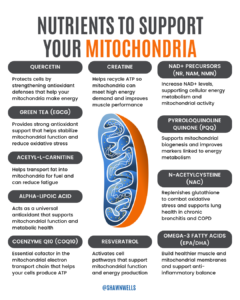
Several nutrients and compounds play roles in mitochondrial energy metabolism. These include magnesium, creatine, CoQ10, omega-3 fatty acids, and L-ergothioneine.
L-ergothioneine is particularly interesting because humans cannot synthesize it and must obtain it from food. Mushrooms are among the richest dietary sources.
The body also uses a dedicated transporter, SLC22A4/OCTN1, to help absorb and distribute ergothioneine. Researchers continue to investigate its physiological role partly because of this highly specific ergothioneine transport system.
Mitochondrial research has added another area of interest. A 2024 study examining ergothioneine uptake into mitochondria detected ergothioneine in isolated mitochondria and in mitochondria from treated cells and animals. The findings add mechanistic support for further research into its role in mitochondrial protection and cellular resilience.
Human outcome data remain limited. Current evidence does not show that ergothioneine supplementation increases VO₂ max or directly improves mitochondrial respiration in healthy adults.
For people who eat few mushrooms or take a longer-term interest in cellular health, L-ergothioneine is worth understanding. I have covered its human research, dietary sources, and dosing considerations in more detail in my article on L-ergothioneine and its potential benefits for mitochondrial and brain health.
MitoPrime® from NNB Nutrition is a fermented source of L-ergothioneine. It is also one of the novel ingredients I have worked with and researched.
I would evaluate any mitochondrial supplement against a clear goal. Compounds used for longer-term cellular support may not produce an immediate sensation. Subjective energy alone is therefore a poor way to judge their usefulness.
When Mitochondrial Testing Requires Medical Evaluation
Health optimization and the evaluation of a possible mitochondrial disorder require very different levels of testing.
Persistent unexplained fatigue, progressive muscle weakness, significant exercise intolerance, neurological changes, or symptoms across several organ systems warrant medical evaluation. Anemia, thyroid disorders, sleep apnea, nutrient deficiencies, infections, cardiovascular disease, medication effects, and many other conditions can cause similar symptoms.
When clinicians suspect a primary mitochondrial disorder, the recommended diagnostic process may involve biochemical testing, genetic analysis, imaging, and, in selected cases, tissue-based testing.
Final Thoughts
There is no single test that captures every aspect of mitochondrial health. Researchers can measure mitochondrial respiration directly, but these methods require specialized laboratory testing and sometimes tissue samples.
For everyday health optimization, VO₂ max, aerobic performance, recovery, metabolic health, and consistent exercise data offer more practical information. Together, they show how well the larger systems involved in energy production are functioning over time.
Regular exercise remains one of the most effective ways to improve mitochondrial capacity. Adequate sleep, recovery, nutrient-dense food, good metabolic health, and targeted supplementation can support that process.
The goal is to preserve the ability to produce energy, tolerate physical demand, recover well, and maintain those capabilities as you get older.
If you want practical, science-backed insights on supplements, energy, healthy aging, and the research worth paying attention to, join my weekly newsletter to stay on top of your health.


Share

Who is Shawn Wells?
Although I’ve suffered from countless issues, including chronic pain, auto-immunity, and depression, those are the very struggles that have led me to becoming a biochemist, formulation scientist, dietitian, and sports nutritionist who is now thriving. My personal experiences, experiments, and trials also have a much deeper purpose: To serve you, educate you, and ultimately help you optimize your health and longevity, reduce pain, and live your best life.



ORDER THE ENERGY FORMULA
Discover the 6 foundational pillars to cultivate a more caring, compassionate, connected, unified and purpose-filled life.
Hardcover, Audible & EBook Available!
UNLEASH YOUR UNLIMITED POTENTIAL
