
How Do You Know If a Supplement Is Working?

Most people judge a supplement by whether they can feel it. For some ingredients, that can be useful information. If you take something for focus, energy, sleep, or digestion, you may notice a change fairly quickly.
Many supplements are harder to judge subjectively. Their effects may show up in training performance, bloodwork, glucose response, nutrient status, sleep quality, or another measurable outcome. Some ingredients used for long-term health may never produce an obvious sensation at all.
I think about this often as a formulator because the question “Does this supplement work?” is incomplete without knowing what you expect it to do.
Before adding something to your routine, it helps to know why you are taking it, what should change if it works, and how long the research suggests you should give it.
Start With a Specific Reason for Taking It
Every supplement should have a clear purpose.
That could be correcting a nutrient deficiency, supporting exercise performance, improving sleep, helping maintain healthy blood sugar, or supporting another specific aspect of your health.
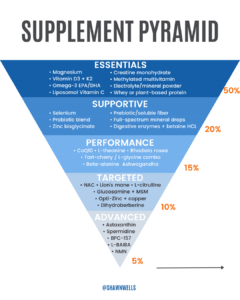
This is also how I approach supplementation more broadly. My Supplement Pyramid starts with foundational needs before moving into more specialized ingredients. There are thousands of compounds with interesting research behind them, but that does not mean they all belong in your routine.
The way you evaluate a supplement should reflect its purpose. Creatine, for example, is better judged by changes in training performance, while vitamin D supplementation may call for follow-up bloodwork if you started with a low level. For an ingredient used to support focus, the more relevant question is whether your concentration, mental endurance, or ability to stay on task actually improves.
Without a defined outcome, it becomes difficult to separate a supplement that is helping from one you have simply grown accustomed to taking.
What Should You Track to Know if a Supplement Is Working?
The right measurement depends on what the supplement is intended to influence.
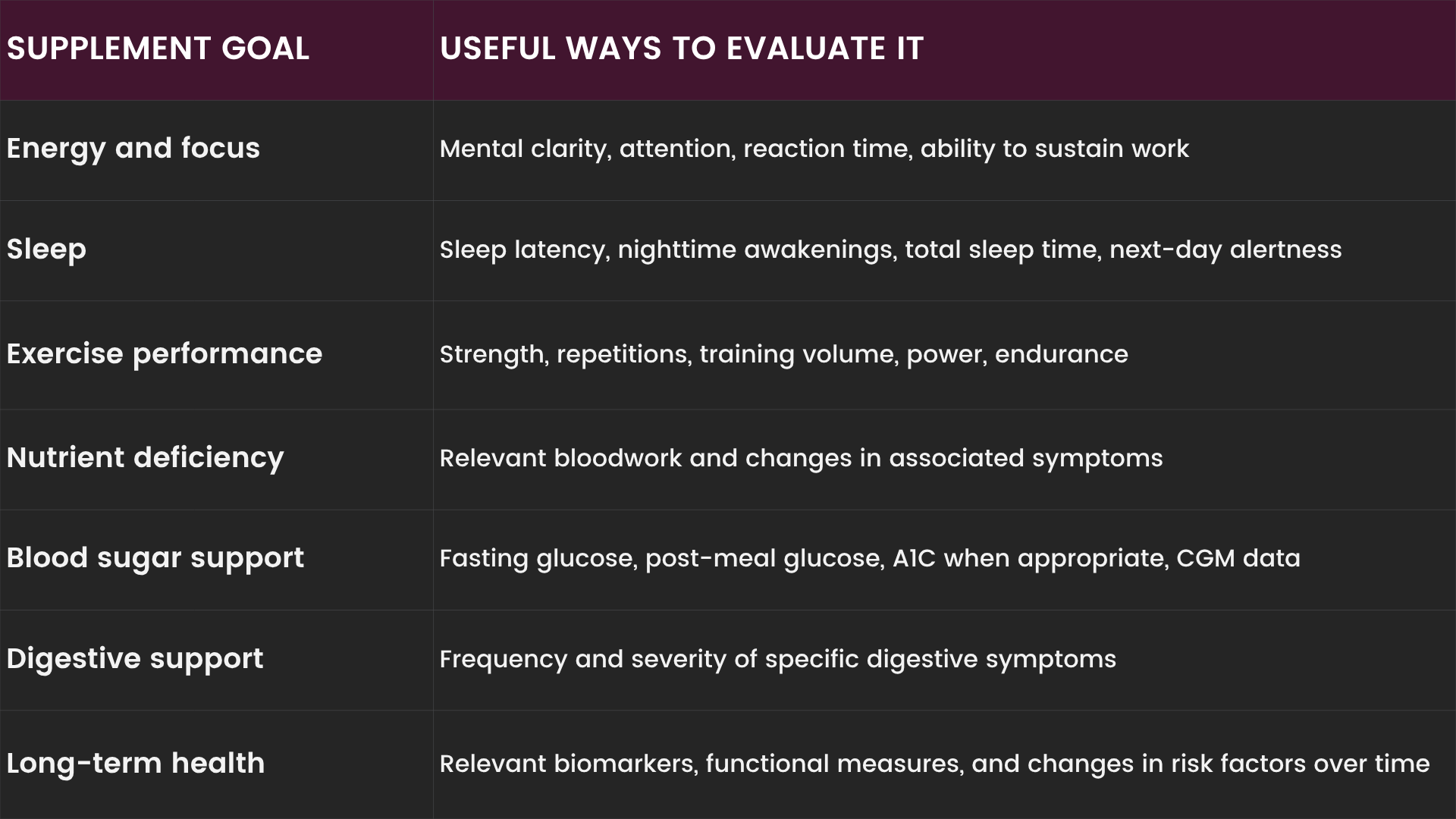
You do not need to track everything. A few measurements that closely match your goal are usually more useful than collecting large amounts of data simply because your wearable or lab report makes them available.
A baseline also helps. If sleep is the goal, spend several days noting how long it takes you to fall asleep, how often you wake during the night, and how rested you feel the next morning. If you are evaluating a performance supplement, use the training metrics you already care about.
The point is to have enough context to recognize whether a meaningful change occurred.
Should You Actually Feel a Supplement Working?
Sometimes, but it depends on what the supplement is designed to do. Feeling an effect can be useful when the intended outcome is something immediate, such as focus or alertness. For other supplements, performance data, bloodwork, or another objective measure will tell you much more.
The way you judge the result should match the reason you are taking the supplement.
Paraxanthine: Look at acute mental performance
Paraxanthine is the primary metabolite produced when your body breaks down caffeine. In a randomized, double-blind crossover trial, researchers evaluated different doses of enfinity® paraxanthine over six hours using measures of cognition, executive function, memory, and reaction time.
If you are using paraxanthine for mental performance, focus, alertness, ability to stay on task, unwanted stimulation, and any effect on sleep later that night are reasonable things to monitor. I cover the research and the differences between paraxanthine and caffeine in more detail elsewhere.
Creatine: Look at training performance over time
You do not need to feel an immediate burst of energy after taking creatine. Research examining creatine accumulation in human skeletal muscle found that approximately 20 grams per day for six days increased muscle creatine stores substantially, while around 3 grams per day produced a similar increase more gradually over several weeks.
If you take creatine for performance, strength, repeated high-intensity work, training volume, and changes in lean mass are more useful indicators than whether you notice a sensation after each dose.
Vitamin D: Look at the appropriate biomarker
Vitamin D is even harder to judge subjectively. Serum 25-hydroxyvitamin D is commonly used to assess vitamin D status, and a randomized clinical trial in adults with vitamin D deficiency found significant increases in serum 25-hydroxyvitamin D after eight weeks of supplementation.
Someone can improve a low vitamin D level without noticing an obvious day-to-day change. In that situation, follow-up testing tells you much more than how you feel after taking the supplement.
How Long Does It Take for a Supplement to Work?
There is no standard timeline that applies to every supplement.
The answer depends on the ingredient, dose, formulation, starting status, consistency, and outcome being measured. An ingredient studied for acute cognitive performance may be evaluated within hours. Muscle creatine stores change over days or weeks depending on the dosing strategy. Correcting a nutrient deficiency can take considerably longer and may require repeat bloodwork.
Human research gives you a reasonable starting point for deciding how long to take a supplement before judging the result. When I evaluate an ingredient, I look at how long it was used before researchers measured the outcome I care about.
If a clinical trial evaluated an ingredient after eight weeks, four days of use is probably too early to make a meaningful judgment. If an ingredient is designed and studied for an acute effect, however, you should not need to use it for months before deciding whether that particular effect is useful to you.
The number of servings in a bottle is not a scientific timeline either. A 30-day supply tells you how the product was packaged. It does not tell you how quickly a physiological change should occur.
Why Feeling a Strong Effect Can Be Misleading
People naturally pay attention to sensations. A stimulant is noticeable. Beta-alanine can produce tingling. Niacin can cause flushing. Those responses confirm that something happened, but they do not tell you how much the supplement improved the health or performance outcome you bought it for.
Many physiological changes are much quieter. Blood nutrient concentrations can change without creating an obvious sensation, just as muscle creatine stores can increase without feeling different after each dose. Changes in glucose regulation may also be easier to see in measurements than in day-to-day symptoms.
The same applies to supplements used for cardiovascular health, mitochondrial function, nutrient status, or healthy aging. There is no reason to expect every useful biological effect to create a noticeable sensation each time you take a capsule.
Subjective feedback still matters when the intended outcome involves things such as energy, cognition, sleep, digestion, or discomfort. It simply needs to be interpreted in the context of what the supplement is actually supposed to influence.
Why Your Supplement May Not Be Working
When a supplement does not seem to be helping, the ingredient itself is only one possibility.
1. It may not address the underlying issue
Fatigue is a good example. Someone may start looking for an energy supplement when the larger issue is inadequate sleep, insufficient calories, iron deficiency, poor recovery, medication effects, metabolic dysfunction, or another health problem.
Supplements can support specific pathways and help address specific nutritional gaps. They cannot reliably compensate for every possible cause of a symptom.
Persistent, severe, or unexplained symptoms deserve proper medical evaluation rather than an increasingly complicated supplement routine.
2. The dose may not match the research
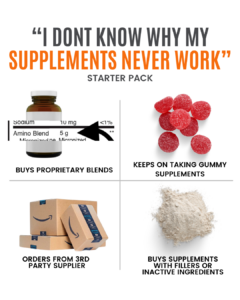
Supplement labels deserve more attention than front-of-package marketing.
I look at how much of the active ingredient is actually present, which form is being used, whether that form has been studied in humans, and whether the amount in the product is reasonably comparable with the clinical research.
This becomes especially relevant with formulas containing a long list of ingredients. A label can look comprehensive while providing very little of each compound. I cover this in more detail in my guide to reading supplement labels.
3. The form can affect how the ingredient behaves
Different forms of an ingredient can influence absorption, stability, solubility, gastrointestinal tolerance, and bioavailability.
Dihydroberberine, or DHB, is a useful example. Standard berberine has relatively poor oral bioavailability. In a small randomized crossover pilot study, researchers compared 500 mg of standard berberine with 100 mg and 200 mg of dihydroberberine using GlucoVantage® from NNB Nutrition.
Both DHB conditions resulted in substantially greater plasma berberine exposure despite being administered at lower doses. The study involved only five healthy men, and it did not find significant differences in glucose or insulin during the short testing period.
From a formulation perspective, the pharmacokinetic findings are useful because they show that changing the form affected berberine exposure. They do not tell us exactly how large the long-term clinical effect will be in different populations. Bioavailability data and clinical outcome data answer related, but separate, questions.
This is the level of detail I look for when evaluating research on a supplement. Mechanism matters. Absorption matters. Human outcomes matter most when we are deciding whether the ingredient is producing a meaningful benefit.
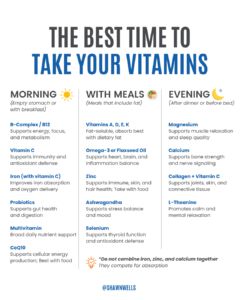
4. Timing or interactions may be affecting the result
Some supplements are relatively flexible about timing. Others are affected by food, competing nutrients, medications, or the way they are combined.
Fat-soluble nutrients are influenced by dietary context. Certain minerals can compete for absorption or interact with medications. Ingredients that influence blood sugar, blood pressure, clotting, or the nervous system can require additional caution when combined with prescription drugs.
I cover these practical considerations in my supplement timing and absorption guide and my article on supplements that should not be taken together.
Timing cannot compensate for a poor formula, but it can affect the performance of a well-formulated one.
5. You may not be taking it consistently enough
Clinical research is usually structured. Participants take a defined amount on a regular schedule for a predetermined period.
Real-world use is often less consistent.
If a supplement is taken several times one week, forgotten for a few days, and used sporadically after that, it becomes difficult to compare your experience with the published research. This matters particularly for ingredients that depend on building or maintaining nutrient status or tissue concentrations over time.
Before increasing the dose or replacing the product, make sure the original supplement was used consistently enough to evaluate.
6. Too many variables may have changed at once
This happens often among people who take their health seriously.
Someone changes their diet, adds several supplements, starts exercising again, reduces alcohol intake, and improves their sleep schedule during the same week. A month later, they feel considerably better, but it is difficult to determine which intervention contributed most.
There is nothing wrong with making several healthy changes at once when your priority is simply improving your health. If you specifically want to learn whether one supplement is helping, introducing one meaningful supplement change at a time gives you much cleaner information.
This is the experimental approach I have used throughout my own work and in The ENERGY Formula. You do not need laboratory conditions. You need enough consistency to learn something useful from the result.
A Practical Way to Evaluate a Supplement
You do not need to turn your routine into a clinical trial, but a little structure makes the result much easier to interpret.
- Decide what you want to change. Choose a specific outcome before starting. For sleep, that might be sleep latency, nighttime awakenings, total sleep time, or next-day alertness. For exercise, it might be strength, repetitions, pace, power output, or training volume.
- Establish a baseline. Track that outcome before introducing the supplement. If a lab value or medical condition is involved, work with an appropriate healthcare professional to determine what should be measured and when it makes sense to reassess it.
- Use the supplement consistently. Choose a form and dose with reasonable support in human research and give it an appropriate amount of time. If you are trying to evaluate that specific supplement, avoid changing several other major variables at the same time.
- Compare the result with your baseline. Look at whether the target outcome changed enough to matter, whether you experienced any side effects, and whether something else could reasonably explain the difference.
Cost belongs in the evaluation too. A supplement can produce a measurable effect and still offer too little practical benefit to justify taking it indefinitely.
When Should You Stop or Reconsider a Supplement?
A supplement deserves another look when it has been used appropriately for a reasonable period and the outcome you were targeting has not improved.
I would also reassess it when:
- The original reason for taking it no longer applies
- A deficiency has been corrected and continued supplementation is no longer indicated
- You develop side effects
- Your medications or health status change
- New research changes what we know about the ingredient
- The benefit is too small to justify the cost or complexity
Long-term use makes sense for some supplements and situations. Others are better suited to a particular goal or period of time.
Periodically reviewing what you take can also prevent unnecessary overlap. Supplement routines tend to grow over time, especially when new products are added without reconsidering the older ones.
Know What Each Supplement Is Doing in Your Routine
I have spent much of my career formulating supplements, and one of the most useful questions I can ask about any ingredient is still very simple: Why am I taking this?
From there, I want to know whether the form and dose make sense, what the human evidence actually shows, how long a reasonable trial should last, and what result would justify continuing it.
That keeps supplementation practical. It also makes it much easier to separate an ingredient that is scientifically interesting from one that actually deserves a place in your routine.
If you want more science-backed insights on supplements, metabolic health, energy, healthy aging, and practical ways to stay on top of your health, you can join my weekly newsletter.
References
- Cashman, K. D., van den Heuvel, E. G. H. M., Schoemaker, R. J. W., Prévéraud, D. P., Macdonald, H. M., & Arcot, J. (2017). 25-Hydroxyvitamin D as a biomarker of vitamin D status and its modeling to inform strategies for prevention of vitamin D deficiency within the population. Advances in Nutrition, 8(6), 947–957.
- Hultman, E., Söderlund, K., Timmons, J. A., Cederblad, G., & Greenhaff, P. L. (1996). Muscle creatine loading in men. Journal of Applied Physiology, 81(1), 232–237.
- Joh, H. K., Hwang, S. S., Cho, B., Lim, C. S., & Jung, S. E. (2020). Effect of sun exposure versus oral vitamin D supplementation on serum 25-hydroxyvitamin D concentrations in young adults: A randomized clinical trial. Clinical Nutrition, 39(3), 727-736.
- Kreider, R. B., Kalman, D. S., Antonio, J., Ziegenfuss, T. N., Wildman, R., Collins, R., Candow, D. G., Kleiner, S. M., Almada, A. L., & Lopez, H. L. (2017). International Society of Sports Nutrition position stand: Safety and efficacy of creatine supplementation in exercise, sport, and medicine. Journal of the International Society of Sports Nutrition, 14, 18.
- Liu, C.-S., Zheng, Y.-R., Zhang, Y.-F., & Long, X.-Y. (2016). Research progress on berberine with a special focus on its oral bioavailability. Fitoterapia, 109, 274–282.
- Moon, J. M., Ratliff, K. M., Hagele, A. M., Stecker, R. A., Mumford, P. W., & Kerksick, C. M. (2022). Absorption kinetics of berberine and dihydroberberine and their impact on glycemia: A randomized, controlled, crossover pilot trial. Nutrients, 14(1), 124.
- Xing, D., Yoo, C., Gonzalez, D., Jenkins, V., Nottingham, K., Dickerson, B., Leonard, M., Ko, J., Faries, M., Kephart, W., Purpura, M., Jäger, R., Wells, S. D., Sowinski, R., Rasmussen, C. J., & Kreider, R. B. (2021). Dose-response of paraxanthine on cognitive function: A double blind, placebo controlled, crossover trial. Nutrients, 13(12), 4478.
Share

Who is Shawn Wells?
Although I’ve suffered from countless issues, including chronic pain, auto-immunity, and depression, those are the very struggles that have led me to becoming a biochemist, formulation scientist, dietitian, and sports nutritionist who is now thriving. My personal experiences, experiments, and trials also have a much deeper purpose: To serve you, educate you, and ultimately help you optimize your health and longevity, reduce pain, and live your best life.



ORDER THE ENERGY FORMULA
Discover the 6 foundational pillars to cultivate a more caring, compassionate, connected, unified and purpose-filled life.
Hardcover, Audible & EBook Available!
UNLEASH YOUR UNLIMITED POTENTIAL
