
Supplements You Shouldn’t Take Together and Why

When people search for supplements you shouldn’t take together, they are usually trying to answer a practical question: could parts of their routine be reducing absorption, creating unnecessary overlap, or affecting how a medication works? That is the right place to start.
In my experience, most issues are not caused by one inherently “bad” supplement. They come from combining otherwise useful ingredients in ways that make them less effective. Once you understand the basics of supplement timing and absorption, it becomes much easier to build a routine that is both simpler and more effective.
Why Supplement Interactions Matter
Your body does not absorb every vitamin, mineral, herb, and medication through a separate pathway.
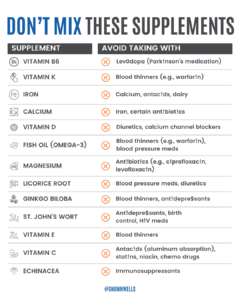
Nutrients do not all move through the body independently. Some compete for uptake in the gut, certain minerals can bind to medications and reduce absorption, and some herbs may influence liver enzymes involved in drug metabolism, which can affect how quickly medications are cleared. Together, these interactions help explain why a supplement stack can look reasonable on paper and still underperform in practice. Research on calcium’s effect on iron absorption is one of the clearest examples, and the interaction between multivalent minerals and certain antibiotics is another.
That is why I do not like fear-based lists that simply tell people what to avoid without explaining why. The more useful question is not just which vitamins do not work well together. It is whether they should be taken together, taken separately, or reviewed more carefully when medications are involved.
Supplements You Shouldn’t Take Together
Here are the combinations I think are most important to understand.
1. Iron and calcium
If you have ever wondered what vitamins should not be taken with iron, calcium is one of the most important to know.
Iron and calcium can compete for absorption when taken at the same time. Human studies have shown that calcium can reduce iron absorption in the short term, especially when both are taken in the same meal or supplement window. That does not mean calcium is harmful or that iron and calcium can never be used on the same day. It means they generally work better when separated. If iron is part of the plan, I usually prefer it away from calcium and often alongside vitamin C, which has been studied for supporting non-heme iron absorption.
2. Magnesium and certain medications
People often ask what vitamins should not be taken together with magnesium, but the more important concern is usually not vitamins. It is medications and other minerals.
Magnesium can bind to certain antibiotics, particularly some fluoroquinolones and tetracyclines, and reduce how much of the drug is absorbed. This interaction has been well described in pharmacokinetic research on quinolones and mineral binding, which is why spacing matters. A few hours can make a meaningful difference depending on the medication. Magnesium can also compete with other minerals when supplemental doses are high. If you want a deeper look at forms, dosing, and practical timing, my magnesium guide goes further into that.
3. Fish oil and blood thinners
Omega-3s have been studied for cardiovascular support and inflammatory balance, but they have also been evaluated for their effects on platelet activity and bleeding risk. The overall evidence is more nuanced than many headlines suggest. A recent meta-analysis in the Journal of the American Heart Association found that bleeding risk overall was not significantly increased across most omega-3 use, although higher-dose purified EPA may deserve more caution in certain settings. I do not consider fish oil something people need to fear, but I do think it warrants closer attention when anticoagulants or antiplatelet drugs are already part of the picture.
4. Vitamin K and warfarin
Vitamin K is directly involved in clotting pathways. Warfarin works by affecting vitamin K dependent clotting factors, which is why sudden changes in vitamin K intake can make management more difficult. The practical issue is not that vitamin K is inherently problematic. It is that consistency matters. Clinical literature on vitamin K intake and warfarin stability suggests that stable intake is often more useful than randomly increasing or restricting vitamin K from week to week.
5. St. John’s wort and antidepressants
If you are asking can supplements interfere with antidepressants, the answer is yes, some absolutely can.
St. John’s wort is one of the best-known examples. Human studies have shown that it can induce drug-metabolizing enzymes such as CYP3A4 and may alter the levels of certain medications. It also raises concern when combined with serotonergic medications, which is one reason it should not be treated like a casual add-on to an antidepressant routine. The classic JAMA review of St. John’s wort interactions remains one of the clearest illustrations of why this herb deserves more respect than it often gets.
If antidepressants are involved, the smarter move is to check every active ingredient carefully and review the full stack before adding anything new.
6. Vitamin C and B12
Another common search is side effects of taking vitamin C and B12 together or what vitamins should not be taken with B12.
This topic tends to get overstated online. There is older lab and supplement-stability research suggesting vitamin C can degrade B12 under certain conditions, especially in solution or with prolonged exposure. But that is not the same as saying a normal daily supplement routine will automatically create a meaningful problem in healthy adults. The concern is more relevant to formulation chemistry and long exposure times than to a basic capsule or tablet routine. If someone wants to be extra careful, spacing them apart is reasonable. I just would not turn this into a blanket rule for everyone. Much of the concern traces back to older work on ascorbic acid and vitamin B12 stability, not strong modern evidence that routine use creates consistent problems.
Which Supplements Should Be Taken Together
This is just as important as which vitamins not to take together.
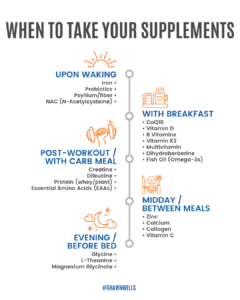
Some combinations make sense because they support absorption or fit the same meal context. Fat-soluble vitamins such as A, D, E, and K generally make more sense with food. Iron often pairs better with vitamin C than with calcium. B vitamins are frequently used together because they work in related metabolic pathways, which is one reason B complex products exist in the first place.
This is also where people ask questions like can I take vitamin B complex and multivitamin together. Usually you can, but that does not automatically mean you should. The more important question is whether you are doubling up on the same nutrients without a clear reason. I would rather see someone compare the label, the forms, and the actual doses before stacking products by habit.
A Simple Framework for Smarter Supplement Timing
You do not need a rigid what vitamins to take together chart to build a better routine. Most people do better with a simple framework.
- Take fat-soluble nutrients with a meal.
- Separate minerals that compete when the dose is high or absorption matters.
- Be more careful when medications are involved.
- Avoid doubling up just because multiple products happen to contain the same nutrient.
That is also how I think about building a stack more strategically. Start with the essentials. Understand the role of each piece. Then add selectively instead of stacking randomly. That same mindset shapes how I approach supplement strategy more broadly.
FAQs
1. Can I take 5 different supplements at once?
Sometimes, yes. The number matters less than the logic behind the combination. A routine built around a multivitamin, omega-3, magnesium, vitamin D, and creatine is very different from taking iron, calcium, zinc, a B complex, and an herb that affects drug metabolism all at once. What matters most is whether there is overlap, nutrient competition, poor timing, or interaction potential.
2 Which vitamins don’t work well together?
This usually comes down to minerals more than vitamins alone. Calcium and iron are one of the most common examples because calcium can reduce iron absorption when taken together. High-dose calcium may also interfere with magnesium or zinc absorption in some situations. The real issue is not that these nutrients are harmful together in every case, but that timing and dose can influence how well they work.
3. Can supplements interfere with antidepressants?
Yes, some can. St. John’s wort is one of the best-known examples because it may affect drug-metabolizing enzymes and interact with serotonergic medications. If antidepressants are involved, it is worth reviewing the full stack carefully with a qualified practitioner rather than layering in herbs casually.
4. What cannot be mixed with vitamin D?
Vitamin D is usually more about context than direct incompatibility. It is fat-soluble, so it generally makes more sense with a meal that contains fat. The bigger concern is when high-dose vitamin D is combined with calcium supplements or medications that affect calcium balance, such as thiazide diuretics. Research published in The American Journal of Medicine highlights why that combination deserves more attention in certain people.
5. Can I take vitamin B complex and multivitamin together?
Usually you can, but that does not always mean you should. A multivitamin already contains many B vitamins, so adding a separate B complex can create unnecessary overlap. Before combining them, it is worth checking the label, the forms, and the doses to make sure there is a clear reason for both.
6. Do I need a what vitamins to take together chart?
Not necessarily. A chart can be helpful as a quick reference, but it does not replace judgment. Most people benefit more from a simple framework: take fat-soluble nutrients with food, separate minerals that compete when absorption matters, and be more careful when medications are involved.
Final Thoughts
If you remember one thing, let it be this: supplements you shouldn’t take together is not just a list. It is a strategy question.
The best supplement routine is usually not the most complicated one. It is the one built around absorption, consistency, and context, with attention to whether nutrients compete, medications change the picture, or ingredients are being doubled up without you realizing it.
That is how you get more value from what you take while avoiding unnecessary mistakes.
And if you want more practical, science-backed insights to help you stay on top of your health, subscribe to my weekly newsletter.
Share

Who is Shawn Wells?
Although I’ve suffered from countless issues, including chronic pain, auto-immunity, and depression, those are the very struggles that have led me to becoming a biochemist, formulation scientist, dietitian, and sports nutritionist who is now thriving. My personal experiences, experiments, and trials also have a much deeper purpose: To serve you, educate you, and ultimately help you optimize your health and longevity, reduce pain, and live your best life.



ORDER THE ENERGY FORMULA
Discover the 6 foundational pillars to cultivate a more caring, compassionate, connected, unified and purpose-filled life.
Hardcover, Audible & EBook Available!
UNLEASH YOUR UNLIMITED POTENTIAL
