
How To Strengthen Your Mitochondria With Food, Lifestyle, And Smart Supplements

If you wake up tired, lean on caffeine to get through the day, and still feel foggy by mid afternoon, this is for you. In this guide I will walk you through how to strengthen your mitochondria using food, movement, and targeted nutrients that fit a real life schedule.
We will look at which foods repair mitochondria, which supplements increase mitochondria, and what is the best way to strengthen your mitochondria without turning health into a full time job. I will also touch on what nutrients are needed for mitochondria, what vitamins help the mitochondria, and how to increase mitochondria naturally in a way that works for busy, health conscious adults.
How To Strengthen Your Mitochondria: Why These Tiny Engines Matter
Mitochondria sit inside almost every cell in your body. Their main job is to turn carbs, fats, and proteins into ATP, the energy currency that runs your muscles, brain, and organs.
People often ask, “Does mitochondria break down nutrients or just use them?” Your gut and digestive enzymes break food into smaller pieces. Mitochondria then pull in those pieces and run them through their own machinery to make ATP. When that machinery works well, you feel steady and clear. When it struggles, you feel like your battery will not hold a charge.
Reviews on mitochondrial health and aging link this dysfunction with fatigue, metabolic disease, and cognitive decline, especially when poor sleep, stress, and ultra processed food pile up over time. If you want a deeper science dive after this, I unpack the full story in an article on mitochondrial health and long term energy.
Which Foods Repair Mitochondria? Your Daily “Mito Plate”
Before we talk about the best mitochondria supplement, we start with mitochondrial nutrients from food. If you get this wrong, no capsule can fully save you.
Color and plants for antioxidant protection
Every time mitochondria make energy, they also create some oxidative stress. Too much can damage their membranes and slow them down. Colorful plants give you antioxidants and polyphenols that buffer this stress.
Think berries, leafy greens, broccoli and other cruciferous veggies, plus herbs and spices like turmeric and rosemary. Polyphenols such as quercetin and catechins have been shown to support mitophagy and mitochondrial resilience in work on polyphenols and mitophagy.
Quercetin from onions and apples and EGCG from green tea are two simple examples. A daily mug of green tea instead of a sugary drink is an easy win if you are wondering how to support mitochondria with almost no extra effort.
Protein and healthy fats for strong membranes
Mitochondria sit inside a fragile fatty membrane. That membrane needs the right building blocks to stay flexible and effective.
Fatty fish like salmon and sardines give you omega 3 fats (EPA and DHA). Olive oil, avocado, nuts, seeds, pasture raised eggs, and grass fed meats fill in the rest. Reviews on omega 3 fatty acids and mitochondria show improvements in mitochondrial bioenergetics and protection against oxidative stress.
A simple “mito plate” you can repeat:
- Half the plate: mixed vegetables and leafy greens cooked in olive oil
- Palm sized protein: salmon, chicken, or a quality plant based protein
- One fourth: roasted sweet potato, quinoa, or another whole food carb
- Bonus: sautéed mushrooms and onions for natural L-ergothioneine and quercetin
Follow this most days and you are already living the answer to which foods repair mitochondria.
What Nutrients Are Needed For Mitochondria? Core Energy Support
Once food is solid, we can talk about supplements to increase mitochondria. You do not need a dozen products. A few well chosen tools can go a long way.
Creatine and CoQ10 for ATP production
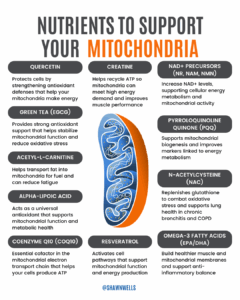
- Creatine helps your cells recycle ATP quickly during high demand in muscles and brain. Your body makes some and you get more from meat and fish, but low daily doses support both physical and cognitive performance in many trials reviewing creatine’s brain and muscle benefits. For everyday life, it is one of the simplest answers when people ask which supplements increase mitochondria output they can actually feel.
- Coenzyme Q10 (CoQ10) sits in the mitochondrial membrane and moves electrons along the chain that creates ATP, while acting as an antioxidant right at the source. A major review on CoQ10 and mitochondrial function reports benefits for energy and heart health, especially as we age or use certain medications.
NAD+ support and acetyl L-carnitine
- NAD+ is a helper molecule many mitochondrial enzymes rely on. Levels often drop with age and chronic stress. Nutrients such as nicotinamide riboside (NR), nicotinamide mononucleotide (NMN), and niacinamide can support NAD+ pools. Clinical work, like an eClinicalMedicine trial in long COVID, suggests that raising NAD+ can improve mitochondrial related symptoms, though the field is still evolving.
- Acetyl L-carnitine (ALCAR) helps shuttle fatty acids into mitochondria where they are burned for fuel. Classic work on acetyl L-carnitine metabolism and newer research on brain plasticity support its role in both energy and mood. When someone asks “what vitamins help the mitochondria,” I often think in terms of this small group of core nutrients rather than a long list.
Antioxidant “Bodyguards” For Mitochondria
Some nutrients help indirectly by defending mitochondria from damage and keeping their membranes healthy. These often show up in any high quality best mitochondria supplement formula:
- Alpha lipoic acid (ALA) helps recycle antioxidants like vitamin C and glutathione and supports mitochondrial enzymes. Clinical work using ALA alongside acetyl L-carnitine has tracked changes in oxidative stress and mitochondrial markers, as seen in a trial combining ALA and ALCAR.
- Quercetin and EGCG from green tea help manage oxidative stress and support mitochondrial signaling. Reviews on quercetin and the mitochondria and follow up work on its ability to preserve mitochondrial function under stress explain why these polyphenols show up so often in healthy aging research.
- Resveratrol from grapes and berries activates cell pathways tied to mitochondrial function and stress resistance. Polyphenol focused papers on mitochondrial dysfunction and resveratrol describe how it can influence mitophagy and energy signaling.
- Omega 3 fats such as EPA and DHA keep cell and mitochondrial membranes fluid and inflammation in check. Reviews looking at omega 3 fatty acids and mitochondria link these fats with better mitochondrial structure and function. If your diet is light on fatty fish, a quality omega 3 is one of the clearest mitochondria supplement benefits you can get from a single product.
How To Increase Mitochondria Naturally With A Simple Stack
So what is the best way to strengthen your mitochondria in the real world? It is not a single “best mitochondria supplement”. It is a simple stack that you can stick with.
- Step 1: Food plus one core nutrient.
Pick one food upgrade and one foundational supplement for a month. For many people, that might be a daily green tea and more vegetables, plus omega 3s if fish is rare in the diet, or creatine if strength and mental energy are big goals. It is a clean, realistic way to start how to increase mitochondria naturally. - Step 2: Add one precision ingredient at a time.
If you still feel off after nailing the basics, add one precision ingredient, not three at once. That might look like layering in CoQ10 if you are over 40 or on certain medications, adding NAD+ support if recovery and resilience are your goals, or using extra antioxidant support such as resveratrol during higher stress seasons. Track energy, mood, focus, and recovery for at least two to four weeks so you can see which supplements to increase mitochondria actually move the needle for you. - Step 3: Match your stack to your real goal.
Steady all day energy might mean omega 3s, creatine, CoQ10, and more plants. Better workout recovery might center on creatine, CoQ10, ALCAR, and sleep. Sharper focus might use green tea or matcha, creatine, and a high protein breakfast. If you want help with timing and combinations, I break down practical strategies in a supplement timing and absorption guide, and I walk through label quality in a simple supplement label checklist.
Best Exercise To Increase Mitochondria
Movement is a huge part of how to strengthen your mitochondria. The best exercise to increase mitochondria is the one you will stick with, but research gives us a clear pattern.
Regular walking keeps blood flow and metabolism steady. A few days per week of strength training protects muscle, which gives mitochondria more tissue to serve. Short sessions of intervals, like alternating brisk walking and easy walking, tell your body to build more and stronger mitochondria. A recent systematic review on exercise and mitochondrial biogenesis in human muscle backs this up.
I share more day to day ideas in a practical guide on mitochondria function hacks for real life.
When To See Your Doctor
Supplements and lifestyle are powerful tools, but they do not replace medical care. Please talk with a doctor if you notice chest pain, shortness of breath, rapid heart rate, unexplained weight loss, severe or sudden fatigue, or new neurological symptoms such as weakness or numbness.
If you live with a chronic condition, are pregnant, or take several medications, review any new supplement plan with your clinician before making changes.
Bringing It All Together
So how to strengthen your mitochondria in a way that actually lasts? Start with one food shift, one core mitochondrial nutrient, and, if it fits your situation, one precision ingredient such as CoQ10, NAD+ support, or a higher quality omega 3. Give your body a few weeks, see how you feel, then adjust. Over time, you build an energy reserve that supports everything else you care about.
If you want help staying on top of this without getting lost in the noise, I share one practical, science backed email each week. No hype, no spam, just real tools you can use to protect your mitochondria and your health. You can join my weekly health newsletter to stay updated on the most important discoveries, the smartest supplement strategies, and the simple habits that keep your energy steady.


Share

Who is Shawn Wells?
Although I’ve suffered from countless issues, including chronic pain, auto-immunity, and depression, those are the very struggles that have led me to becoming a biochemist, formulation scientist, dietitian, and sports nutritionist who is now thriving. My personal experiences, experiments, and trials also have a much deeper purpose: To serve you, educate you, and ultimately help you optimize your health and longevity, reduce pain, and live your best life.



ORDER THE ENERGY FORMULA
Discover the 6 foundational pillars to cultivate a more caring, compassionate, connected, unified and purpose-filled life.
Hardcover, Audible & EBook Available!
UNLEASH YOUR UNLIMITED POTENTIAL
