
Microplastic Detox Protocol: Science-Backed Ways to Protect Your Body

Every day you breathe, eat, and drink, you ingest tiny fragments of plastic. In a 2024 study researchers detected microplastics in 80% of human blood samples, confirming these particles move beyond the gut and into circulation. That finding makes a microplastic detox protocol an urgent health step. Learning how to detox microplastics naturally can protect your hormones, gut health, and long-term well-being.
What Counts as Micro- and Nanoplastics?
Microplastics are fragments under 5 mm; nanoplastics are smaller than 100 nm. You encounter them from:
- Water supplies: Tap water tests often reveal dozens of particles per liter, making filter microplastics from drinking water essential.
- Airborne fibers: Synthetic clothing sheds thousands of microfibers during washing and wear.
- Food packaging: Chemicals like BPA and PFAS can leach into food and beverages, creating the need for a focused BPA detox and PFAS detox.
- Personal care products: Microbeads are still found in some scrubs and toothpastes.
Each route adds to your daily microplastics load. A strong microplastics detox plan must address both ingestion and inhalation.
How Tiny Plastics Disrupt Hormones, Gut, and Immunity
Even low-level exposure to microplastics can trigger:
- Endocrine disruption
BPA and similar chemicals mimic hormones, altering fertility and thyroid markers. - Oxidative stress
Reactive oxygen species increase when particles lodge in tissues, driving inflammation. - Gut dysbiosis
Fragments disturb your microbiome, reducing diversity and weakening the intestinal barrier.
A comprehensive review highlights that microplastics often carry toxic additives on their surfaces, amplifying damage when ingested. This is why a science-backed microplastic detox routine is more than a trend—it is a necessity.
Your Gut Barrier: First Line of Defense in a Microplastic Detox Protocol
Your intestinal lining decides which compounds enter circulation. A robust mucus layer and healthy gut cells can trap many toxins. But when microplastics erode this barrier, particles slip through and travel to organs. Strengthening your gut integrity is the first step to remove microplastics from body effectively.
Probiotic Strains That Bind Microplastics
Certain microbes act like biological sponges that capture plastics in the gut:
- Lactobacillus casei (kefir, yogurt, aged cheese)
- Bifidobacterium breve (fermented milk, supplements)
- Lactobacillus plantarum (kimchi, sauerkraut, sourdough)
These are some of the best probiotic strains for microplastic detox and probiotics microplastics binding. Early rodent-to-human data suggest they latch onto BPA, PFAS, and polystyrene fragments, then escort them out in stool rather than letting them cross into your bloodstream.
The Microplastic Detox Protocol Routine
To get the most from your microplastic detox protocol, combine these daily pillars into one coordinated plan:
- Targeted probiotic blend
Take a supplement delivering at least 10 billion CFU each of L. casei, B. breve, and L. plantarum first thing in the morning. These probiotics microplastics binders help trap BPA and PFAS in the gut before they can enter your bloodstream. - Algal binder
Mix 2 g of chlorella or spirulina into water or a smoothie. These algae act as natural binders that support a BPA detox and PFAS detox by escorting microplastics out with your stool. - High-fiber intake
Aim for 30 g of fiber daily from psyllium husk, oats, fruits, and vegetables. Fiber increases stool bulk and accelerates how to remove microplastics from body. - Filtered drinking water
Drink at least 2 L of water filtered through a 0.2 µm countertop system to filter microplastics from drinking water. Clean water supports healthy bowel movements and overall microplastics detox.
When you follow this science-backed microplastic detox routine, each element amplifies the others. Probiotics bind plastics, binders trap them, fiber sweeps them out, and clean water keeps your system flushing efficiently.
If you’d like to explore products I personally trust, check out my Detox & Liver Health Stack as a convenient resource.
Lifestyle Upgrades to Slash Plastic Exposure
Pair your detox routine with simple swaps that cut down new intake of microplastics:
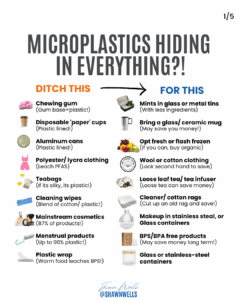
- Glass food containers – prevent leaching of plastic chemicals into meals.
- Natural-fiber clothing – cotton, wool, hemp, and bamboo shed far fewer microfibers than synthetics.
- Avoid microwaving plastic – heat speeds up plastic migration even from “microwave-safe” tubs.
- Plastic-free cosmetics – choose products without microbeads (PE, PP) and in glass or aluminum packaging.
- Limit shellfish – bottom-feeders like mussels and oysters accumulate microplastics from the ocean.
Each upgrade lowers your daily burden, making the microplastic detox protocol more effective.
Myth Busting: What Does Not Work in Microplastics Detox
Separate fact from fiction to protect your health without wasting time or money:
- Sweating it out – saunas and workouts tone your body but do not expel microplastics through sweat.
- Juice cleanses – low-fiber diets slow gut transit and let plastics linger.
- Detox teas – most rely on mild laxatives rather than true binders, risking dehydration.
- Blood-filter clinics – still experimental, costly, and unproven for plastic removal.
Stick to methods shown to work by research rather than untested trends.
Run a 30-Day Self-Test
Track your results to see how well your microplastic detox protocol is working:
- Baseline labs
Order hs-CRP and basic liver panels before you begin. - Daily log
Note energy levels, digestive comfort, skin clarity, and mood each morning. - Follow-up labs
After 30 days, retest hs-CRP and compare results to your baseline.
Seeing measurable improvements in both lab values and how you feel is the best proof that your protocol is moving microplastics out of your body.
Take Control with Your Microplastic Detox Protocol
A focused microplastic detox protocol is within reach when you combine targeted probiotics, natural binders, high-fiber foods, and practical lifestyle upgrades. This approach helps you guard against hormonal disruption, oxidative stress, and gut dysbiosis caused by tiny plastic particles.
Ready for more science-backed, actionable insights? Subscribe to my newsletter to get fresh strategies delivered to your inbox each week. Keep moving toward your best health with information you can trust.
 .
. 
References
Dris, R., Gasperi, J., Mirande, C., Mandin, C., Guerrouache, M., Langlois, V., & Tassin, B. (2017). A first overview of textile microplastic fibers in indoor and outdoor environments. Environmental Pollution, 221, 453–458.
Jadhav, S., & Xu, H. (2017). Biosorption of heavy metals by exopolysaccharides produced by Lactobacillus rhamnosus: Equilibrium and kinetic studies. Journal of Environmental Management, 202, 105–113.
Jin, Y., Lu, L., Tu, W., Luo, T., & Fu, Z. (2019). Impacts of polystyrene microplastics on the gut microbiome and behavior of mice. Environmental Science & Technology, 53(14), 8336–8345.
Kosuth, M., Mason, S. A., & Wattenberg, E. V. (2018). Anthropogenic contamination of tap water, beer, and sea salt. PLOS ONE, 13(4), e0194970.
Leonard, S. V. L., Liddle, C. R., Atherall, C. A., Chapman, E., Watkins, M., Calaminus, S. D. J., & Rotchell, J. M. (2024). Microplastics in human blood: Polymer types, concentrations and characterisation using μFTIR. Environment International. Advance online publication.
Pan, I., & Umapathy, S. (2024). Probiotics an emerging therapeutic approach towards gut-brain-axis oriented chronic health issues induced by microplastics: A comprehensive review. Heliyon, 10(3), e13821.
Qiu, H., Ying, X., & Piver, W. (2015). Removal of microplastics in drinking water treatment: Focus on micrometer sized particles. Environmental Science: Water Research & Technology, 1(7), 758–767.
Rochester, J. R. (2013). Bisphenol A and human health: A review of the literature. Reproductive Toxicology, 42, 132–155.
Slavin, J. L. (2013). Fiber and prebiotics: Mechanisms and health benefits. Nutrients, 5(4), 1417–1435.
Sunderland, E. M., Hu, X. C., Dassuncao, C., Tokranov, A. K., Wagner, C. C., & Allen, J. G. (2019). A review of the pathways of human exposure to poly- and perfluoroalkyl substances (PFASs) and present understanding of health effects. Journal of Exposure Science & Environmental Epidemiology, 29(2), 131–147.
Share

Who is Shawn Wells?
Although I’ve suffered from countless issues, including chronic pain, auto-immunity, and depression, those are the very struggles that have led me to becoming a biochemist, formulation scientist, dietitian, and sports nutritionist who is now thriving. My personal experiences, experiments, and trials also have a much deeper purpose: To serve you, educate you, and ultimately help you optimize your health and longevity, reduce pain, and live your best life.

ORDER THE ENERGY FORMULA
Discover the 6 foundational pillars to cultivate a more caring, compassionate, connected, unified and purpose-filled life.
Hardcover, Audible & EBook Available!
UNLEASH YOUR UNLIMITED POTENTIAL
