
L-Theanine for Sleep: Does It Actually Help?
If you’re looking into L-theanine for sleep, you’re probably not looking for a heavy sedative. More often, you’re trying to figure out whether something can help when you feel exhausted but your mind still won’t shut off. That’s where L-theanine becomes interesting. The best current research suggests it may support sleep quality, help with sleep onset, and improve next-day function, especially when stress and mental overactivation are part of the problem.
What L-theanine May Actually Do for Sleep
L-theanine is a naturally occurring amino acid found in tea, and its value for sleep seems to come less from sedation and more from helping the brain shift into a calmer state. That same body of research points to benefits in subjective sleep quality, sleep onset latency, and daytime dysfunction, which is why L-theanine tends to make the most sense for people who feel tired in body but wired in mind.
That distinction matters because whether L-theanine is good for sleeping depends on why you are not sleeping in the first place. If your issue is a racing mind, low-grade stress, or difficulty downshifting at night, L-theanine makes a lot more sense than it would for something like sleep apnea, alcohol-disrupted sleep, or a chronically poor routine. That is also why it fits naturally into a broader conversation around sleep support, where the goal is matching the right tool to the real bottleneck.
What The Research Says, and Where People Overstate It
The research is promising, but it still needs to be framed honestly.
The strongest recent evidence suggests L-theanine has potential in the management of sleep disturbances, while also making clear that we still need more research on pure L-theanine on its own, along with better clarity around ideal dose and duration. So yes, the evidence is worth taking seriously, but not in a way that treats L-theanine like a cure-all.
There is also broader literature suggesting theanine may support mood and cognitive outcomes, which helps explain why many people describe feeling calmer rather than drowsier. That does not prove a sleep effect by itself, but it does support the idea that theanine may shift the mental state that often gets in the way of sleep.
When I’d Consider L-theanine for Sleep
In practice, I think L-theanine for sleep makes the most sense for the person who is tired in body but wired in mind.
That might look like lying in bed replaying conversations, feeling mentally switched on long after your body is ready to sleep, or wanting help winding down without feeling drugged the next morning.
That is also why many L-theanine for sleep reviews tend to sound similar. People often do not say it knocked them out. They say they felt calmer, less mentally activated, and more ready to fall asleep. That lines up well with human research showing reduced perceived stress and improved sleep quality in moderately stressed adults.
Timing: How Long Before Bed Should I Take L-theanine?
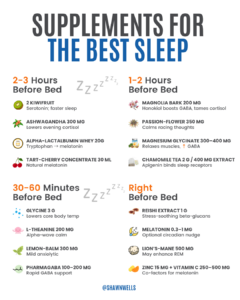
For most people, a practical starting point is about 30-60 minutes before bed.
That is the clearest answer to how long before bed should I take L-theanine? You do not need to overcomplicate the first trial. If your goal is better sleep, take it before bed and keep the rest of your variables as stable as possible. Since the current evidence still leaves some uncertainty around optimal dosing and duration, consistency matters more than chasing the perfect minute on the clock.
That said, when to take L-theanine morning or night depends on the goal. Morning can make sense when you want calm focus. Night makes more sense when you want help stepping out of a stress-heavy state before sleep. Same ingredient, different use case.
Dosage: Start Lower than You Think You Need
A lot of people jump straight to dose, but I think the better move is to start with a clean, moderate trial.
For sleep support, 100-200 mg is a sensible place to begin. That gives you a real test without assuming more is better. So, will 200mg of L-theanine make you sleepy? Usually not in the way a sedative would. What it may do is help reduce the mental friction that is keeping you awake. For many people, that calmer state is enough to make sleep easier to access. That fits the broader research, which points more toward better sleep quality and easier sleep onset than toward strong sedation.
When people ask about 400 mg of L-theanine for sleep, I see that as a question that needs more context, not a simple yes or no. The same goes for 600 mg L-theanine for sleep. Just because higher amounts may appear in research settings does not mean they should become the default recommendation. The more responsible takeaway is still to begin with a moderate dose, track the response, and only go higher if there is a clear reason to do so.
Side Effects and Who Should Be Careful
If you are wondering what the negative side effects of L-theanine are, the main point is that it appears to be generally well tolerated, but that is not the same thing as saying it is risk free.
Research on 28 days of L-theanine supplementation in moderately stressed healthy adults found it to be safe and well tolerated, which is encouraging. Still, that does not mean everybody responds the same way, especially when dose, stacking, medications, and underlying sleep issues vary from person to person.
I’d be more cautious if you’re pregnant, breastfeeding, taking medications that affect the nervous system, or trying to solve persistent insomnia with supplements alone. If your sleep has been off for a while, I think it’s worth stepping back and looking at the bigger picture, not just adding another capsule. That’s also why I’d pair this with my guide on the best supplements for sleep, because the right support depends on what’s actually driving the issue.
L-Theanine and Magnesium for Sleep
This is where the conversation gets more practical.
A lot of people are really deciding between L-theanine and magnesium for sleep, or wondering whether taking both makes more sense. I do not see these as interchangeable. I see them as supporting different parts of the same problem.
If the issue is mental overactivation, I’d usually look at L-theanine first. If the issue is more about physical tension, poor relaxation, or a broader nutrient gap, magnesium may be the better foundation. I think that distinction matters, because for some people the bigger issue is not just stress, but depletion and nervous system strain.
That is also the cleanest way to think about L-theanine vs magnesium for sleep. It is not always an either-or question. If someone is both wired and tense, L-theanine and magnesium for sleep may be a more logical combination than choosing one and hoping it covers everything.
How to Take L-Theanine for Sleep
My bias is always to test one variable at a time.
If I were trialing L-theanine for sleep, I’d start with 200 mg, take it 30-60 minutes before bed, and keep everything else as stable as possible for 10-14 nights. Then I’d track a few simple things: how long it takes me to fall asleep, whether I wake during the night, how I feel when I wake up, and whether bedtime feels mentally easier.
That kind of clean self-experiment tells me far more than stacking multiple ingredients and hoping for the best.
A few options I’d consider
If you want a few simple reference points, here are the kinds of options I’d look at depending on how you want to approach L-theanine for sleep:
- NOW Foods L-Theanine 200 mg
I’d look at this kind of option if I wanted a straightforward 200 mg dose before bed without adding too many moving parts. It fits well with the moderate starting range I’d recommend for most people. - Nutricost L-Theanine 200 mg
This is another simple 200 mg L-theanine option that makes sense if the goal is to test a commonly used dose for evening wind-down and see how your body responds. - Doctor’s Best L-Theanine with Suntheanine, 150 mg
I’d consider something like this if I wanted a slightly gentler entry point. A lower-dose option can be useful if you’re more sensitive to supplements or simply prefer to start more conservatively. - Magnesium
If the issue feels less like a racing mind and more like physical tension, poor relaxation, or broader depletion, I’d keep magnesium in the conversation too. In some cases, L-theanine and magnesium for sleep make more sense together than trying to force one ingredient to do everything.
The goal here is not to build a giant stack right away. It’s to start with a simple, reasonable option, pay attention to how you respond, and adjust based on your actual pattern.
The Bottom Line
L-theanine for sleep is most compelling when the problem is not a lack of tiredness, but an inability to downshift. That is where the evidence and real-world use line up best. It may help improve sleep quality, support sleep onset, and reduce next-day dysfunction, but it is best understood as a calming support tool, not a sedative.
Start with the basics. Use a moderate dose. Track what changes. And do not ignore magnesium if tension and depletion are also part of the picture.
If you want more practical, science-backed tips to help you stay on top of your health, join my weekly newsletter.

References
Bulman, A., D’Cunha, N. M., Marx, W., Turner, M., McKune, A., & Naumovski, N. (2025). The effects of L-theanine consumption on sleep outcomes: A systematic review and meta-analysis. Sleep medicine reviews, 81, 102076.
Moulin, M., Crowley, D. C., Xiong, L., Guthrie, N., & Lewis, E. D. (2024). Safety and Efficacy of AlphaWave® l-Theanine supplementation for 28 days in healthy adults with moderate stress: a Randomized, Double-Blind, placebo-controlled trial. Neurology and therapy, 13(4), 1135-1153.
Payne, E. R., Aceves-Martins, M., Dubost, J., Greyling, A., & de Roos, B. (2025). Effects of tea (Camellia sinensis) or its bioactive compounds l-theanine or l-theanine plus caffeine on cognition, sleep, and mood in healthy participants: A systematic review and meta-analysis of randomized controlled trials. Nutrition reviews, 83(10), 1873-1891.
Share

Who is Shawn Wells?
Although I’ve suffered from countless issues, including chronic pain, auto-immunity, and depression, those are the very struggles that have led me to becoming a biochemist, formulation scientist, dietitian, and sports nutritionist who is now thriving. My personal experiences, experiments, and trials also have a much deeper purpose: To serve you, educate you, and ultimately help you optimize your health and longevity, reduce pain, and live your best life.



ORDER THE ENERGY FORMULA
Discover the 6 foundational pillars to cultivate a more caring, compassionate, connected, unified and purpose-filled life.
Hardcover, Audible & EBook Available!
UNLEASH YOUR UNLIMITED POTENTIAL
