
Magnesium and Calcium: Your Muscle On/Off Switch

When people feel tight, crampy, or slower to recover, they often ask me about magnesium vs calcium for muscles. They want to know what matters more, what to take, and whether one mineral can “fix” the whole problem. The truth is more useful than a simple yes or no. Your muscles need both minerals working together because every movement requires a clean contraction signal and an equally clean reset.
Minerals are not medications, and results vary. The science includes human trials, plus mechanistic and preclinical work that helps explain how this system operates. My goal here is to give you a clear framework so you can make smarter choices with food, hydration, and supplements without chasing extremes.
Magnesium vs Calcium for Muscles, Simplified
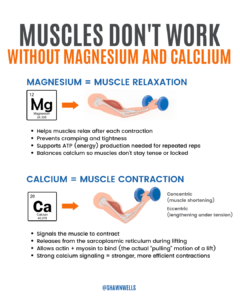
Every rep, step, and sprint has two jobs. Your muscle has to contract with force, and then it has to relax fully so you can repeat the effort. Calcium is central to the contraction signal. Magnesium supports the “reset” side of that cycle so the muscle can return to baseline and fire again efficiently.
This contract and relax loop sits inside what researchers call excitation contraction coupling, and it is described clearly in this open access overview of excitation contraction coupling in skeletal muscle. If this cycle runs smoothly, movement feels strong, coordinated, and repeatable. When it does not, you often notice tightness, fatigue, twitchiness, or cramps.
Magnesium and Muscle Contraction Are Connected
Calcium acts like the main “go” signal inside the muscle fiber. When your nervous system tells a muscle to move, calcium is released inside the cell and enables the proteins that generate force to do their work. That is why calcium is foundational for performance.
What gets overlooked is that calcium also has to clear back down after each contraction. If it stays elevated too long, the muscle can feel like it never fully lets go. This is where magnesium becomes relevant. Magnesium does not replace calcium. It supports the processes that help restore balance after contraction so the next rep can be efficient instead of forced.
If you want a deeper physiology view on how calcium is handled in muscle, this paper on calcium handling and muscle contraction helps connect the dots between signaling and repeated effort.
Does Magnesium Relax Muscles?
People ask me this directly, and the best answer is that magnesium can support relaxation for some people because it plays a role in both energy use and neuromuscular excitability. One key detail is that ATP is commonly used as a magnesium ATP complex in the body. ATP helps power the pumps and enzymes that restore balance after a contraction. Mechanistic research on magnesium and cell energetics explores this connection in more detail.
This is also why you will see magnesium discussed as support for both muscles and nerves. Muscle control is not just the muscle tissue itself. It is also the nervous system signaling when to fire and when to stop. If magnesium status is low, nerves and muscles may become more reactive, which can feel like tension, twitching, or a cramp-prone baseline. That said, magnesium is not a guaranteed fix. It is one piece of a larger system that includes hydration, sleep, training load, and overall diet.
Is Calcium and Magnesium Good for Muscles?
Yes. Both minerals are essential, and your body uses them every day. Calcium supports force production, while magnesium supports recovery between contractions and steadier signaling.
Where many people run into trouble is not a total lack of calcium or magnesium, but an imbalance created by diet and lifestyle. In the US, calcium intake can be high because it is found in dairy, fortified foods, and many multivitamins. Magnesium can be easier to miss because it is concentrated in foods many people under-eat, including leafy greens, beans, nuts, and seeds. When you add sweating, stress, inconsistent sleep, and high training volume, magnesium demand can climb.
That is one reason magnesium vs calcium for muscles often becomes a “reset” conversation. Many people already have plenty of calcium inputs. Fewer people consistently cover magnesium.
Is It Better to Take Calcium or Magnesium?
This depends on what you already get from food and what your goal is. If your diet is low in both, you may need to raise both through food first. If your diet is already calcium heavy, magnesium often deserves more attention.
Calcium supplementation is not automatically wrong. The key is context. If you already meet calcium needs through food, adding a high-dose supplement may not improve performance or recovery, and it can push the system toward more “on” signaling without improving the “off” side. If you are unsure where you stand, a food log for a few days can be more helpful than guessing.
Hydration also matters. If you sweat a lot and replace only water, you can dilute minerals that muscles rely on. That is not about fear. It is just basic physiology.
Why Is Calcium No Longer Recommended?
This question usually comes from headlines. Calcium is still essential. What has shifted is the idea that everyone should automatically take high-dose calcium supplements regardless of diet. Many clinicians now lean food-first for calcium, then supplement only when it fills a real gap or fits a specific need.
The main misconception I want to prevent is thinking that “less blanket supplementing” means “calcium is bad”. Calcium remains part of every contraction. The goal is appropriate intake, not extremes.
If you genuinely need supplemental calcium because your diet is consistently low, here is a straightforward example with a clean label and a simple formula:
- Pure Encapsulations Calcium (Citrate)
Calcium citrate. Often better tolerated than some other forms, and easy to fit with meals if you need supplemental calcium.
Which Magnesium for Muscle Recovery and Relaxation?
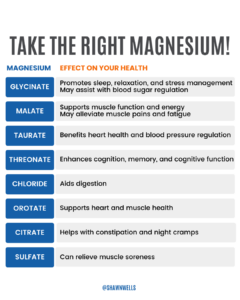
When people ask which form to choose, I focus on the goal and tolerance. For relaxation support, many people do well with magnesium glycinate. It tends to be gentle and is commonly used when the goal is calming and sleep support.
If someone asks which magnesium is best for muscle recovery, I bring the conversation back to nervous system downshift. Recovery is not only muscle tissue. It is also how well you shift out of “on mode” after training so you can actually adapt.
People also ask about magnesium for muscle pain. Magnesium is not a pain medication, and I do not frame it that way. But if discomfort is tied to tightness, poor relaxation, or cramp-prone signaling, improving magnesium status may support a better baseline for some people over time.
If your goal is muscle relaxation and a calmer nervous system, magnesium glycinate is a common starting point:
- Double Wood Magnesium Glycinate
Capsule option with a straightforward glycinate focus. A simple pick if you want an easy nightly routine. - Pure Encapsulations Magnesium (Glycinate)
Minimalist formula style. Useful for people who want fewer extras and tend to be sensitive to additives.
Should I Take Magnesium to Build Muscle?
Magnesium does not build muscle by itself. Training, protein, calories, and sleep drive hypertrophy. What magnesium can do is support the systems that make training more consistent and recovery more reliable, including energy production and neuromuscular signaling. If low magnesium status is holding you back, correcting that gap may support better performance and fewer “bad sessions”, which is often what actually moves results.
I also like to keep expectations grounded. Human trials on cramps are mixed depending on the group and the magnesium form used. For example, this randomized study in JAMA Internal Medicine found magnesium oxide was not significantly better than placebo for nocturnal leg cramps in older adults. Different context than athletes, but it reinforces a smart approach. Do not assume one mineral explains everything.
Conclusion: A Straightforward Plan You Can Start This Week
If you want the most practical takeaway from magnesium vs calcium for muscles, think balance first. Support contraction and relaxation, not just one side of the cycle. Start with food and hydration, then consider supplements if they fit your needs and you tolerate them well.
Here are a few quick wins that help many people without overcomplicating it.
- Pair calcium-rich foods with magnesium-rich foods in the same meal
- Replace heavy sweat losses with minerals, not only plain water
- If relaxation is your goal, consider magnesium glycinate later in the day
- Avoid stacking high-dose calcium on top of a calcium-heavy diet without a clear reason
- Track one signal for 7 days, tightness, cramp frequency, or sleep quality
If you want a clear breakdown of magnesium forms and how to choose based on your goal, I put everything in one place in my Magnesium Guide.
References
Bolaños, P., & Calderón, J. C. (2022). Excitation-contraction coupling in mammalian skeletal muscle: Blending old and last-decade research. Frontiers in Physiology, 13, 989796.
Kleczkowski, L. A., & Igamberdiev, A. U. (2023). Magnesium and cell energetics: At the junction of metabolism of adenylate and non-adenylate nucleotides. Journal of Plant Physiology, 280, 153901.
Maor, N. R., Alperin, M., Shturman, E., Khairaldeen, H., Friedman, M., Karkabi, K., & Milman, U. (2017). Effect of magnesium oxide supplementation on nocturnal leg cramps: a randomized clinical trial. JAMA internal medicine, 177(5), 617-623.
Shishmarev, D. (2020). Excitation-contraction coupling in skeletal muscle: recent progress and unanswered questions. Biophysical reviews, 12(1), 143-153.
Share

Who is Shawn Wells?
Although I’ve suffered from countless issues, including chronic pain, auto-immunity, and depression, those are the very struggles that have led me to becoming a biochemist, formulation scientist, dietitian, and sports nutritionist who is now thriving. My personal experiences, experiments, and trials also have a much deeper purpose: To serve you, educate you, and ultimately help you optimize your health and longevity, reduce pain, and live your best life.



ORDER THE ENERGY FORMULA
Discover the 6 foundational pillars to cultivate a more caring, compassionate, connected, unified and purpose-filled life.
Hardcover, Audible & EBook Available!
UNLEASH YOUR UNLIMITED POTENTIAL
